Key takeaways
- Know why and where you are cutting.
- Use clean sharp bypass tools.
- Do not remove more healthy growth than roots can support.
- Pruning cannot repair low light or poor placement.
Why this care task matters
Pruning removes plant tissue to improve health, direct growth, control size, take cuttings, or remove hazards. A cut changes how the plant allocates stored energy and where buds can grow. The correct point depends on whether the plant branches from nodes, grows from a central crown, forms canes, or produces fronds.
Palms generally cannot replace a removed central growing point, and rosette plants may be disfigured by cutting the crown. Vines and many branching foliage plants respond well to cuts above a node. Identify the growth habit before using a general pruning rule.
In practice, the worst pruning damage is removing healthy foliage for shape. A plant's roots need leaves to recover and grow; stripping a plant down to a neat outline in one sitting can stall it for months. Prune for a reason, keep the canopy dense, and work in stages.
Sanitize between plants, especially after cutting anything with discolored, soft, or spotted tissue. A single shared pair of pruners is the easiest way to move a problem through a collection; wiping blades with alcohol takes seconds and should become routine.
Tools and materials
- Sharp bypass pruners
- Fine scissors for soft stems
- 70 percent isopropyl alcohol
- Gloves for irritating sap
Step by step
- Define the goal
Mark dead, diseased, crossing, unbalanced, or excessively long growth. Avoid cutting healthy tissue without a specific outcome.
- Sanitize and inspect tools
Remove debris, disinfect blades, and confirm they close cleanly. Use a tool sized to the stem instead of crushing it.
- Find the growth point
On branching stems, cut just above a healthy node facing the desired direction. Remove dead leaves at their natural attachment without tearing the stem.
- Work in stages
Step back after several cuts. Preserve enough foliage for photosynthesis and avoid removing a large percentage during other stresses.
- Monitor the wound and new growth
Keep conditions stable, clean sap safely, and watch for dieback, rot, or the expected buds over the following weeks.
Common mistakes
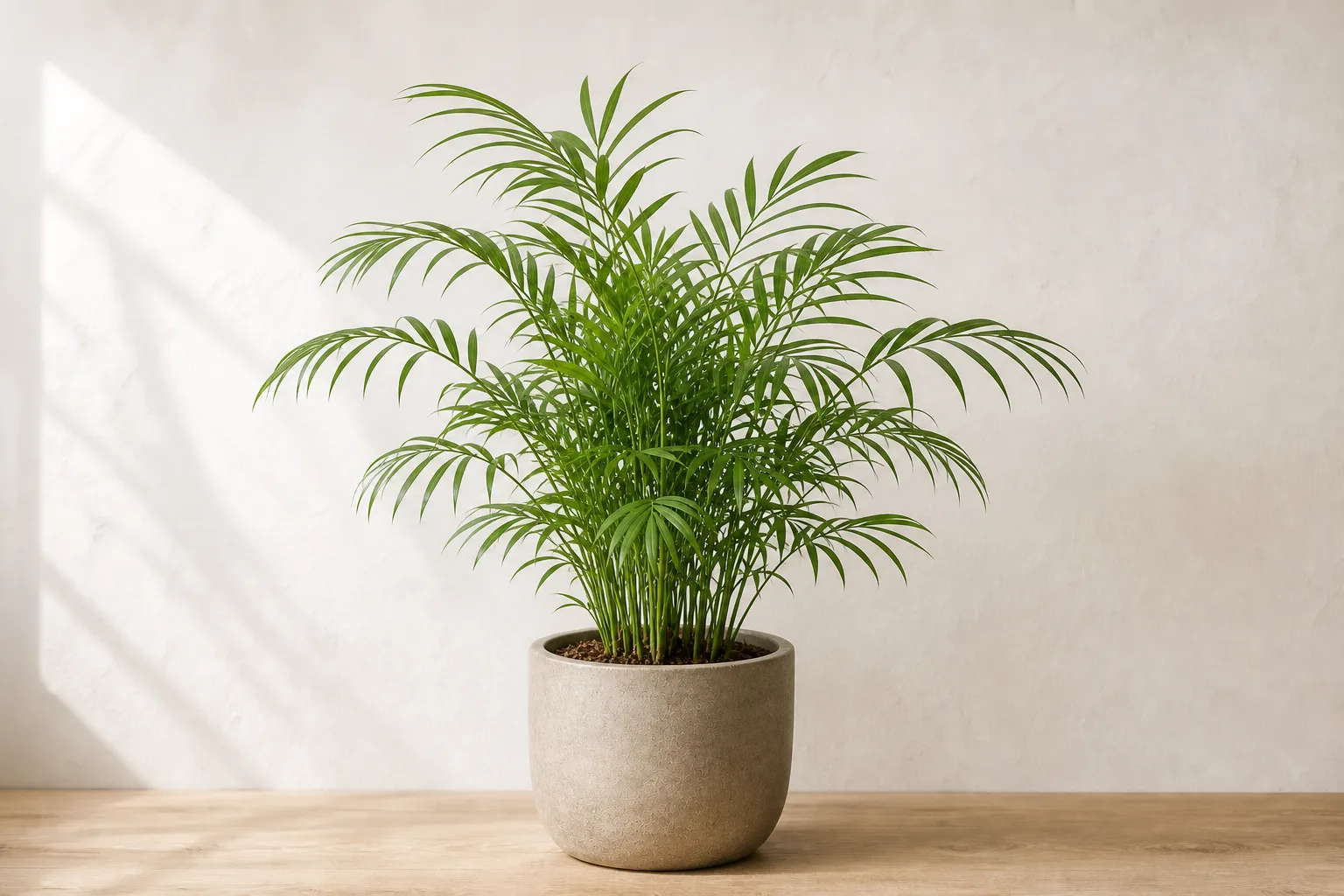
Remove only fully dead fronds according to species guidance; loss of the active crown can kill that stem.
Improve light first so replacement growth develops compactly instead of repeating the same stretch.
Recut cleanly with a sharp bypass tool and disinfect before moving to another plant.
Season and environment
- Active growth often supports faster recovery, but dead, broken, or diseased tissue can require removal in any season.
- Plants with irritating latex or oxalate sap require gloves, eye protection, and cleanup away from children and pets.
- A recently repotted, drought-stressed, or pest-damaged plant may need foliage for recovery; delay cosmetic pruning.
When to stop or seek help
- Stop if the plant has a single crown or unfamiliar growth point and a wrong cut could remove all active growth.
- Consult a qualified professional for large indoor trees, stems under tension, toxic sap reactions, or suspected systemic disease.
Frequently asked questions
How much can I prune at once?
For routine shaping, remove conservatively and reassess. The safe amount varies with species, health, season, and how much active foliage remains.
Will cutting above a node create two branches?
It can activate one or more buds on branching plants, but species, light, hormones, and plant vigor determine the result.
Should yellow leaves be removed?
Fully yellow leaves will not recover and can be removed cleanly. First diagnose widespread yellowing so pruning does not hide a root or care problem.
Can pruned pieces be propagated?
Healthy stems with the correct node or growth tissue can often be used, but propagation method is species-specific.
Sources and further reading
- Spring houseplant careUniversity of Minnesota Extension. Seasonal assessment, gradual light changes, leaf cleaning, watering, feeding, and outdoor transition.
- Leaf damage on houseplantsRoyal Horticultural Society. Distinguishing natural aging, water stress, light injury, temperature fluctuation, and root problems.
- Managing insects on indoor plantsUniversity of Minnesota Extension. Plant inspection, isolation, sanitation, watering, and safe indoor pest management.
Houseplant care varies with light, pot size, climate, and season. Use this guide as a starting point and adjust to what your plant and home show you; when a problem is severe or hard to identify, consult a qualified horticulturist or your local extension service.