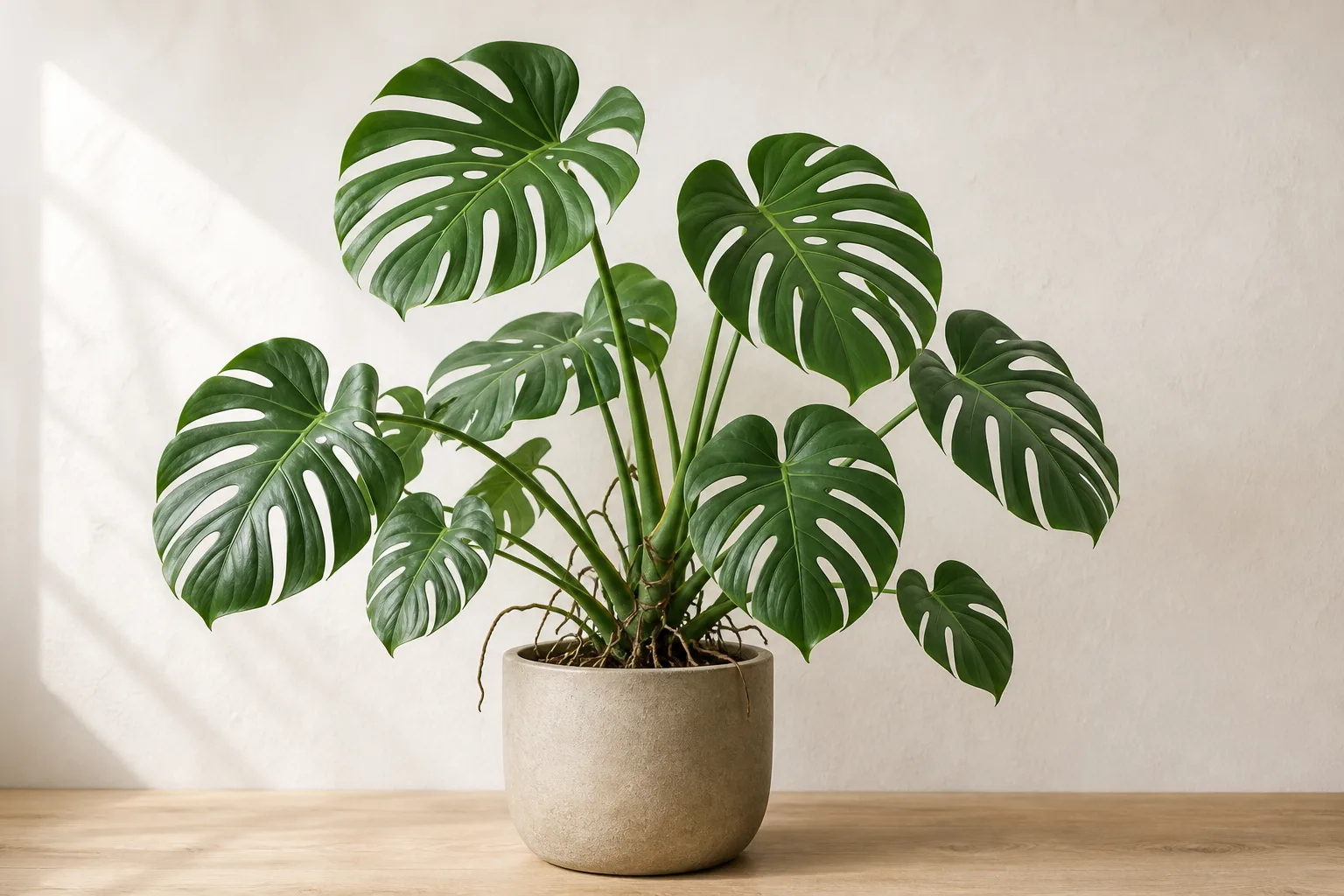
Key takeaways
- Bright indirect light supports larger, split leaves.
- Let the top 2 inches of soil dry before watering.
- Keep away from pets that chew plants.
How to care for Monstera
Monstera deliciosa is a climbing evergreen vine in the arum family, not a true philodendron. In its native wet-tropical habitat it uses aerial roots to climb, and indoors it keeps the same basic habit: stems lengthen toward light and mature plants need a sturdy pole, plank, or trellis to stay upright. A supported plant is easier to position and can produce progressively larger leaves when its other needs are met.
Young leaves are usually whole. The familiar cuts and internal holes, called fenestrations, become more pronounced as the plant matures under suitable light and support. Indoor plants commonly reach about 6 to 8 feet, though available space, container size, support, and growing conditions all affect the final size. Flowers and fruit are unusual in ordinary homes, so judge success by steady roots, firm stems, and healthy new foliage rather than blooms.
Light
Give Monstera bright filtered light or moderate indoor light without prolonged harsh sun. An east-facing window, or a position set back from a brighter south- or west-facing window, is often easier to manage than an exposed hot window. Exact distance depends on glass, season, latitude, nearby buildings, and whether a sheer curtain softens the light, so watch the plant rather than relying on a universal number of feet.
Long spaces between leaves, strongly leaning stems, and persistently small new leaves can point to insufficient light, although age and lack of support also affect leaf size and fenestration. Pale or scorched patches after a move can indicate that light increased too quickly. Acclimate the plant gradually when moving it closer to stronger sun, especially after winter or a period in a dimmer room.
Water
Check the potting mix before watering. For a mature indoor plant, the upper 1 to 2 inches should feel dry while the mix below still retains some moisture. Water thoroughly until excess drains from the pot, then empty the saucer. A small sip may wet only part of the root ball, while leaving the pot standing in water reduces the air available to roots.
Drying time changes with light, temperature, season, pot material, root density, and the amount of mix around the roots. Growth and water use usually slow in lower winter light, so the interval often lengthens. Yellowing leaves together with mix that stays wet, a sour smell, or soft dark roots deserves investigation before more water is added. A single older lower leaf can also yellow naturally, so look for a pattern rather than reacting to one leaf.
Soil and repotting
Use a loose, well-drained houseplant mix in a container with a drainage hole. A chunky aroid-style mix can combine a quality potting mix with coarse bark and another porous amendment, but the useful test is performance: water should move through the pot while the root ball retains moderate moisture instead of becoming compacted or remaining saturated for many days.
Repot when roots circle densely, emerge from drainage holes, or the root ball dries unusually fast despite thorough watering. Move up only one practical pot size; a large volume of unused wet mix can stay damp around a relatively small root system. Spring is a convenient time to repot and install a support, but an actively deteriorating root system should be assessed when the problem appears rather than waiting for a calendar date.
Temperature, humidity, and fertilizer
Monstera grows well in the warm temperatures typical of occupied homes. Keep it away from cold drafts, heating vents, and abrupt temperature swings. Average household humidity can support the plant, while higher humidity may reduce rapid moisture loss around new leaves. Humidity does not compensate for saturated roots, and constantly wet foliage or poor air movement can create other problems.
Fertilizer is most useful when the plant is actively growing in adequate light. During spring and summer growth, a balanced houseplant fertilizer can be used conservatively according to its label; University of Minnesota Extension suggests beginning gently rather than overfeeding. Reduce or pause feeding when growth slows, and never use fertilizer as a treatment for roots stressed by waterlogged mix. Salt buildup can contribute to damaged leaf edges, so avoid exceeding the label and periodically water thoroughly enough for excess to drain.
Pruning and propagation
Prune with clean, sharp tools to remove damaged growth or shorten a stem that has outgrown its support. Make the purpose of each cut clear before cutting: removing a leaf differs from taking a viable propagation cutting. A leaf and its petiole may remain attractive in water for a time, but they cannot form a new shoot without a piece of stem that includes a node and an axillary bud.
Monstera can be propagated by stem cuttings or layering. For a cutting, identify a node on the stem, cut below it, and place the node in a moist, well-drained rooting medium while keeping the leaf above the surface. Roots and new growth take time; avoid repeatedly disturbing the cutting to check progress. Once a rooted cutting is established, move it into a proportionate container and resume normal care gradually.
- A node is the point on the stem where a leaf and potential new growth originate.
- An aerial root alone does not replace the need for a node on a propagation cutting.
- Layering allows a node to root while it remains attached to the parent plant.
Common problems
Start with the pattern, current soil moisture, and recent changes. One symptom can have several causes, so change the most likely factor first and observe before making another major adjustment.
| Symptom | Check first | First action |
|---|---|---|
| Yellow leaves | Soil moisture, root condition, leaf age, and how quickly the change spread | Pause automatic watering and inspect the mix before changing several care variables |
| Brown or crisp edges | Recent drying, hot direct sun, fertilizer use, and water-quality changes | Stabilize moisture and light, then review feeding and accumulated salts |
| New leaves stay small or unsplit | Plant age, available light, vertical support, and overall growth rate | Improve support and filtered light gradually; do not cut healthy juvenile leaves |
| Plant leans or sprawls | Direction of light and whether stems are attached to a stable support | Add or reposition support and rotate only gradually so leaves can readjust |
| Mix stays wet for many days | Drainage hole, pot size, mix compaction, light, temperature, and root health | Stop watering until the cause is understood; inspect roots if decline continues |
Pet and household safety
Monstera deliciosa is toxic to cats and dogs if chewed. ASPCA identifies insoluble calcium oxalate crystals as the toxic principle; possible signs include oral irritation, pain or swelling around the mouth, drooling, vomiting, and difficulty swallowing. Keep the plant out of reach of pets and children who chew plants. After suspected pet ingestion, contact a veterinarian or animal poison-control service promptly, especially when symptoms are present.
Frequently asked questions
How often should I water Monstera?
Use the potting mix, not a fixed weekday, as the trigger. Water thoroughly when the upper 1 to 2 inches are dry, then let excess drain. The interval changes with season, light, pot size, mix, and root density.
Why are my Monstera leaves not splitting?
Juvenile leaves are naturally whole. Mature fenestrations are more likely when the plant has enough filtered light, time, healthy roots, and vertical support. Increase light gradually and avoid treating an otherwise healthy young plant as defective.
Does Monstera need a moss pole?
It needs reliable support as it matures, but that support does not have to be a moss pole. A sturdy pole, plank, or trellis can keep the climbing stems upright. Attach stems loosely and avoid fastening leaf petioles that need to move.
Can Monstera grow in low light?
It may survive in lower light, but growth is usually slower and new leaves may remain smaller or less fenestrated. Medium to bright filtered light is a more reliable target. Avoid moving a low-light plant directly into harsh sun.
What should I do with aerial roots?
Aerial roots are part of the plant's climbing habit. Guide them toward a support or into the pot when practical. They can also be shortened with clean tools if they are unmanageable, but removing them does not replace the need for stable stem support.
Is Monstera safe for pets?
No. ASPCA lists Monstera deliciosa as toxic to cats and dogs because chewing exposes the mouth to insoluble calcium oxalate crystals. Keep the plant out of reach and contact a veterinarian or animal poison-control service after a concerning exposure.
Sources and editorial review
This editorial draft is based on the sources below and awaits named horticulture-expert approval before publication.
- Monstera deliciosa — Plant FinderMissouri Botanical Garden · Checked
- Monstera deliciosa — Extension Gardener Plant ToolboxNC State Extension · Checked
- Monstera deliciosa Liebm.Royal Botanic Gardens, Kew — Plants of the World Online · Checked
- Toxic and Non-toxic Plants: CerimanASPCA · Checked
- Monstera deliciosaUniversity of Minnesota Extension · Checked
- Spring houseplant careUniversity of Minnesota Extension · Checked
What works well
- Fast growth in good light
- Easy to propagate
- Dramatic foliage
What to consider
- Toxic if chewed
- Needs space and support
- Prone to root rot in wet soil