Key takeaways
- Give the container full sun and an open drainage hole.
- Water after the mix partly dries rather than keeping it wet.
- Keep all Pelargonium foliage and flowers away from pets.
How to care for Zonal Geranium
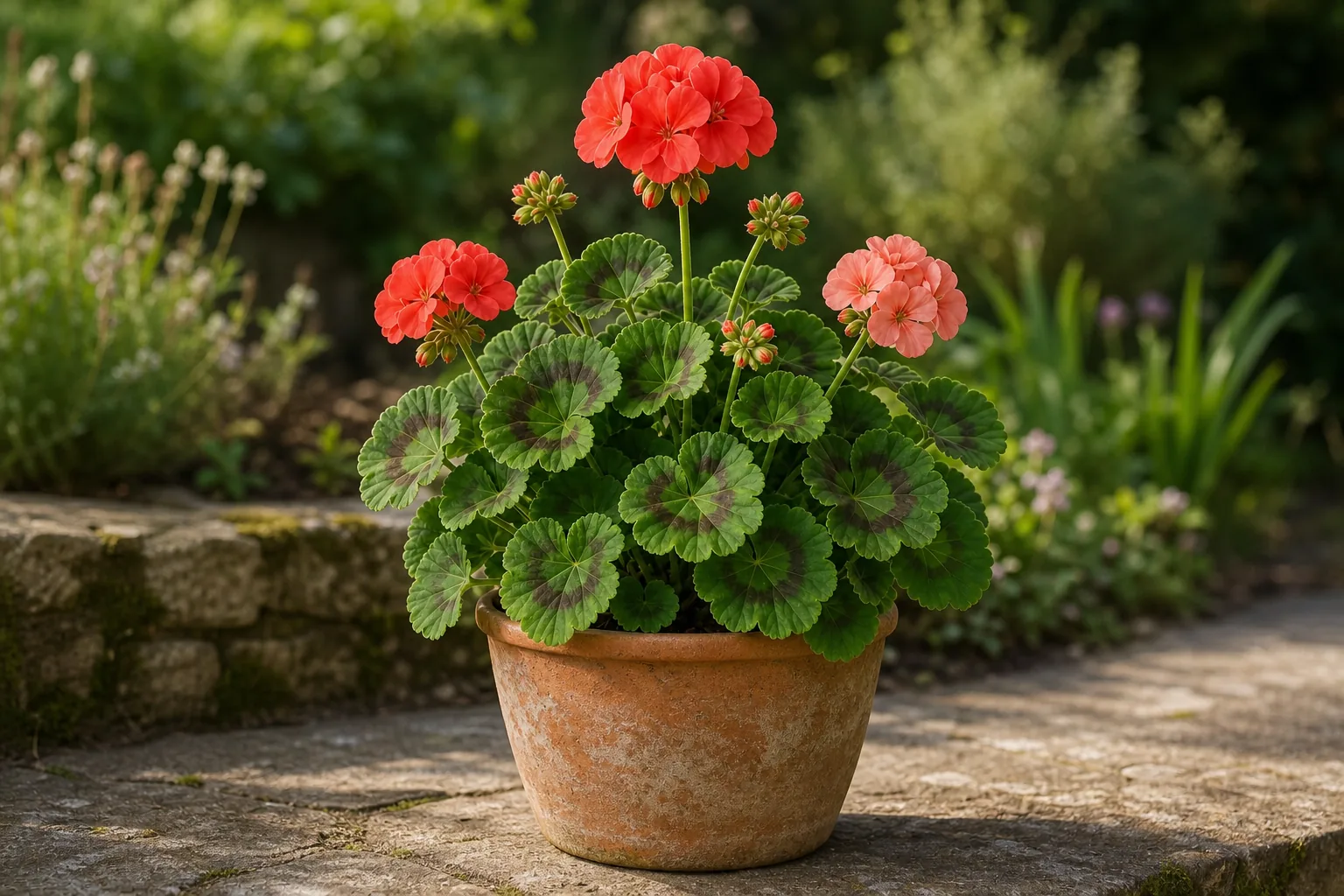
Pelargonium × hybridum is a tender garden hybrid commonly grown as a seasonal container plant. Choose an upright zonal cultivar rather than confusing it with true hardy Geranium, and give each plant enough airflow for its rounded canopy.
Light
Full sun supports compact growth and repeated flower clusters. Plants moved outdoors from a greenhouse or winter room need gradual exposure; low light produces long internodes and fewer flowers.
Water
Water thoroughly after the upper potting mix begins to dry, then empty any saucer. Zonal geraniums tolerate a short dry interval better than a constantly wet root ball, but prolonged drought aborts flowers and scorches leaf edges.
Soil and repotting
Use a clean, well-drained container mix in a pot with an open hole. Repot overwintered plants when roots crowd the container, removing only clearly dead roots and keeping the stem base at its original depth.
Temperature, humidity, and fertilizer
Keep plants frost-free and provide ventilation in humid or enclosed locations. A restrained balanced feed during active flowering is appropriate for containers, but excess nitrogen favors leaves over blooms.
Pruning and propagation
Remove spent flower stalks at their base and pinch soft tips when a bushier plant is needed. Root healthy stem cuttings in a clean medium; discard material from plants with bacterial or systemic disease symptoms.
Common problems
Start with the pattern, current soil moisture, and recent changes. One symptom can have several causes, so change the most likely factor first and observe before making another major adjustment.
| Symptom | Check first | First action |
|---|---|---|
| Few flowers and long stems | Check direct sun and whether fertilizer is nitrogen-heavy. | Increase light gradually and pause excessive feeding. |
| Yellow soft lower leaves | Check whether the mix stays wet and the saucer holds water. | Let the mix partly dry and restore drainage. |
| Corky brown leaf patches | Check humidity, watering swings, and ventilation. | Improve airflow and keep moisture more even. |
| Gray fuzzy flowers | Check spent blooms and cool, damp, crowded conditions. | Remove affected flowers and increase ventilation. |
| Plant collapses after a cold night | Check the recorded low and water-soaked tissue. | Move surviving plants frost-free and remove only dead material. |
Pet and household safety
ASPCA classifies Pelargonium species as toxic to cats and dogs and lists geraniol and linalool as toxic principles. Keep pots and fallen flowers out of reach. Contact a veterinarian after ingestion or signs such as vomiting, appetite loss, depression, or skin irritation.
Frequently asked questions
How often should I water Zonal Geranium?
Water after the upper mix begins to dry, then drain completely; heat and pot size change the interval.
Does Zonal Geranium need full sun?
Full sun produces the best compact growth and flowering, with gradual acclimation after indoor conditions.
Why is my Zonal Geranium not flowering?
Review light first, then excessive nitrogen, temperature, and prolonged drought.
Can I overwinter Zonal Geranium?
Yes, frost-free in strong light or in a cool managed dormant state, though replacing it is often simpler.
How do I propagate Zonal Geranium?
Take healthy stem cuttings or grow seed strains; cuttings preserve the parent cultivar.
Is Zonal Geranium safe for pets?
No. ASPCA classifies Pelargonium species as toxic to cats and dogs.
Sources and editorial review
This editorial draft is based on the sources below and awaits named horticulture-expert approval before publication.
- Pelargonium × hybridumNC State Extension · Checked
- Pelargonium × hortorum L.H.BaileyRoyal Botanic Gardens, Kew — Plants of the World Online · Checked
- Growing geraniums as annual flowers in MinnesotaUniversity of Minnesota Extension · Checked
- GeraniumASPCA · Checked
What works well
- Reliable container color
- Easy from cuttings
- Many compact cultivars
What to consider
- Toxic to pets
- Killed by frost
- Poor bloom in low light