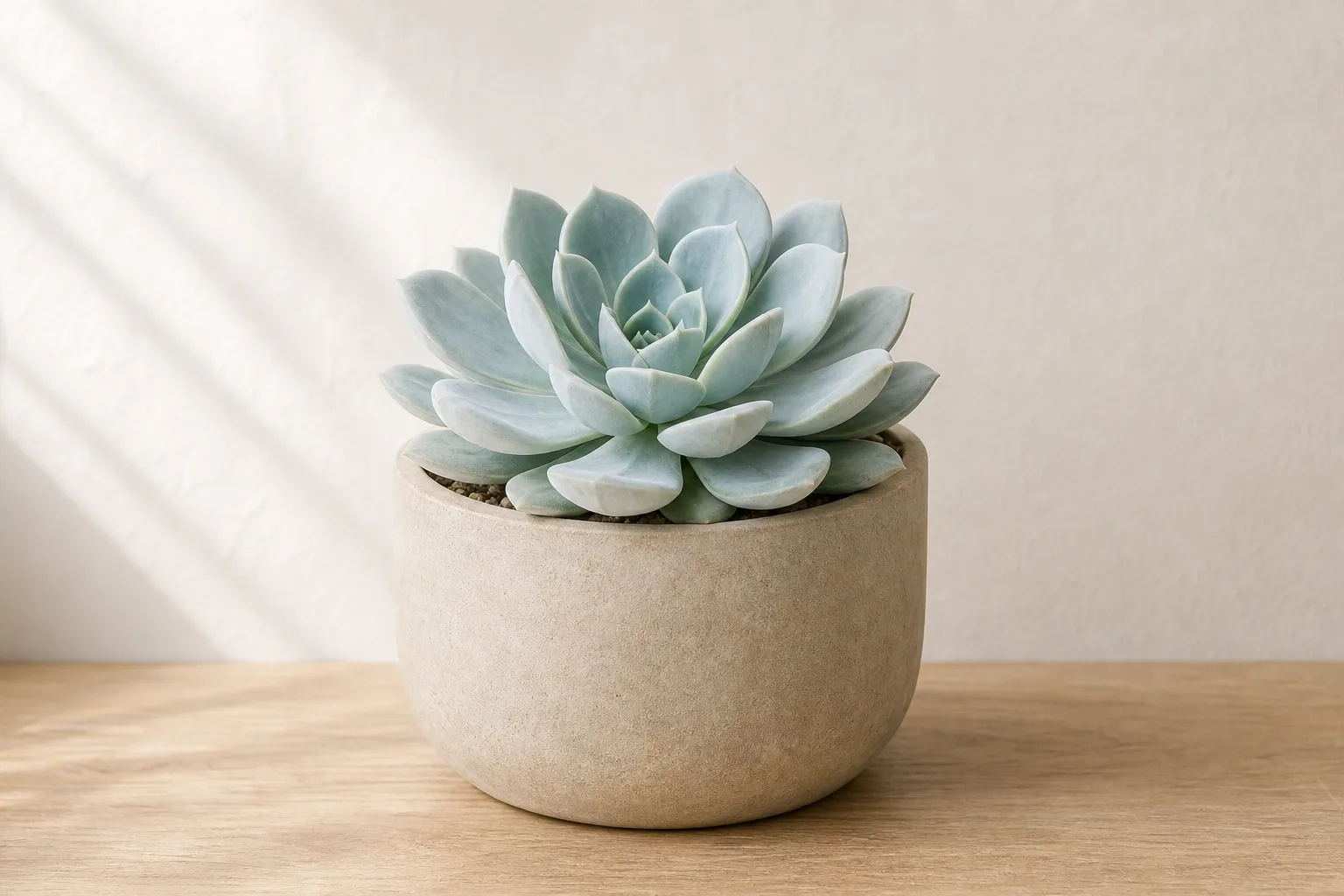
Key takeaways
- Give it bright indirect light to full sun; strong light keeps the rosette tight.
- Water deeply only when the mix is completely dry, then drain well.
- Listed as non-toxic to cats and dogs and propagates easily from offsets or leaves.
How to care for Mexican Snowball
Mexican snowball (Echeveria elegans) is a compact succulent native to the dry scrub of northeastern Mexico. Its leaves are spoon-shaped, pale blue-green, and covered in a natural powdery coating (farina) that shields them from strong sun - touch it and the fingerprints stay. The rosettes stay tight and symmetrical in good light and send up slender stalks of pink, lantern-shaped flowers tipped with yellow in winter and spring.
This is an easy succulent when given what it wants: as much bright light as a home can offer, a fast-draining mix, and a genuine dry-down between deep waterings. It stretches and loses its rosette form in dim spots, and it rots when the mix stays wet. Outdoors it tolerates some frost, but indoors it is simply a bright-window plant that rarely needs fussing.
Light
Give Echeveria elegans bright indirect light to as much direct sun as a sunny windowsill provides - south or west windows are ideal. Strong light keeps the rosettes compact and encourages the pink edge tones, while too little light makes the stems stretch and the leaves flatten and pale. In very hot summer windows, a sheer curtain can prevent scorching. Rotate the pot occasionally so the rosette grows evenly.
Water
Water deeply when the mix has dried out completely, then let every drop drain and empty the saucer. In a bright, warm room that may be every one to two weeks; in cooler or dimmer months it stretches to a month or more. The plant stores water in its leaves, so a slightly dry spell is always safer than extra water. Keep water out of the rosette's center, which invites rot, and reduce watering sharply in winter.
Soil and repotting
Use a fast-draining cactus or succulent mix, ideally amended with extra perlite or coarse grit, in a pot with a drainage hole. Repot in spring when the rosette fills the pot or offsets crowd the edge - typically every one to two years. Go up only one pot size, since a large pot holds moisture the small root system cannot use. After repotting, wait a few days before watering so any damaged roots can heal.
Temperature, humidity, and fertilizer
Mexican snowball prefers warm, dry conditions (roughly 60-80°F / 16-27°C) and tolerates low indoor humidity well. It can handle a little frost outdoors in mild climates but should be protected from freezing; indoors, keep it away from cold, drafty windows in winter. Feed sparingly - once or twice during spring and summer with a diluted succulent fertilizer - and skip feeding in winter when growth stops.
Pruning and propagation
Remove dried or damaged lower leaves as they fade, and cut spent flower stalks back at the base. Propagation is easy from offsets (small rosettes around the parent) or from individual leaves: twist a healthy leaf off cleanly, let the end dry for a few days, and lay it on damp mix until a new rosette forms. Offsets with roots attached establish fastest. Handle leaves gently so you do not disturb the powdery coating.
Common problems
Start with the pattern, current soil moisture, and recent changes. One symptom can have several causes, so change the most likely factor first and observe before making another major adjustment.
| Symptom | Check first | First action |
|---|---|---|
| Stretched, leggy rosette | Light levels and how far the plant sits from the window | Move gradually to stronger light and increase the dry interval between waterings. |
| Soft, mushy, or translucent leaves | Watering frequency and whether the pot drains | Stop watering, let the mix dry completely, and inspect the roots for rot. |
| Wrinkled or shriveled leaves | How long the mix has been dry and the health of the roots | Water deeply and let excess drain; plump leaves should return within days. |
| Pale, flat leaves or fading color | Light intensity and whether the plant is reaching for the window | Move gradually to brighter light and avoid overwatering. |
| White cottony insects or sticky residue | Leaf joints, undersides, and new growth for mealybugs | Isolate the plant, remove visible pests, and treat with a targeted control. |
Pet and household safety
Echeveria elegans is listed as non-toxic to cats and dogs, and the Crassulaceae family includes many commonly cultivated non-toxic succulents. Non-toxic does not mean edible: chewing any plant material can still cause mild stomach upset, so keep persistent chewers away and contact a veterinarian if a pet becomes unwell.
Frequently asked questions
How often should I water a Mexican snowball?
Only when the mix is completely dry - often every one to two weeks in a bright room and much less in winter. The plant stores water in its leaves and rots when kept wet.
What light does a Mexican snowball need?
Bright indirect light to full sun. Strong light keeps the rosette tight and colorful; dim light makes it stretch and flatten.
Why is the leaf surface powdery?
The powdery coating is natural farina that shields the leaves from intense sun. Fingerprints and smudges do not fade, so handle the rosette by the pot when possible.
How do I propagate a Mexican snowball?
By offsets or leaf cuttings. Twist a healthy leaf off cleanly, let the end callus for a few days, and lay it on damp mix until a small rosette appears.
Can a Mexican snowball survive outdoors?
In mild, frost-free climates it can grow in a sunny, fast-draining spot, but it is usually grown as a bright-window houseplant. Protect it from freezing and heavy rain.
Is a Mexican snowball safe for pets?
Yes, it is listed as non-toxic to cats and dogs. Still discourage chewing, since any plant material can cause stomach upset.
Sources and editorial review
This editorial draft is based on the sources below and awaits named horticulture-expert approval before publication.
- Echeveria elegansRoyal Botanic Gardens, Kew (Plants of the World Online) · Checked
- Toxic and Non-Toxic Plants ListASPCA · Checked
- Echeveria elegansNorth Carolina State University Extension · Checked
- Echeveria elegansRoyal Horticultural Society · Checked
What works well
- Tight, sculptural rosettes with a soft powdery coating.
- Very low maintenance once light and drainage are right.
- Listed as non-toxic to cats and dogs.
What to consider
- Stretches and loses its form in low light.
- Rot follows overwatering or a pot that does not drain.
- The powdery coating smudges easily if handled.