Key takeaways
- Plant a young tree because established roots dislike disturbance.
- Avoid waterlogged soil and protect moisture during establishment.
- Use part shade where summers are very hot.
How to care for Eastern Redbud
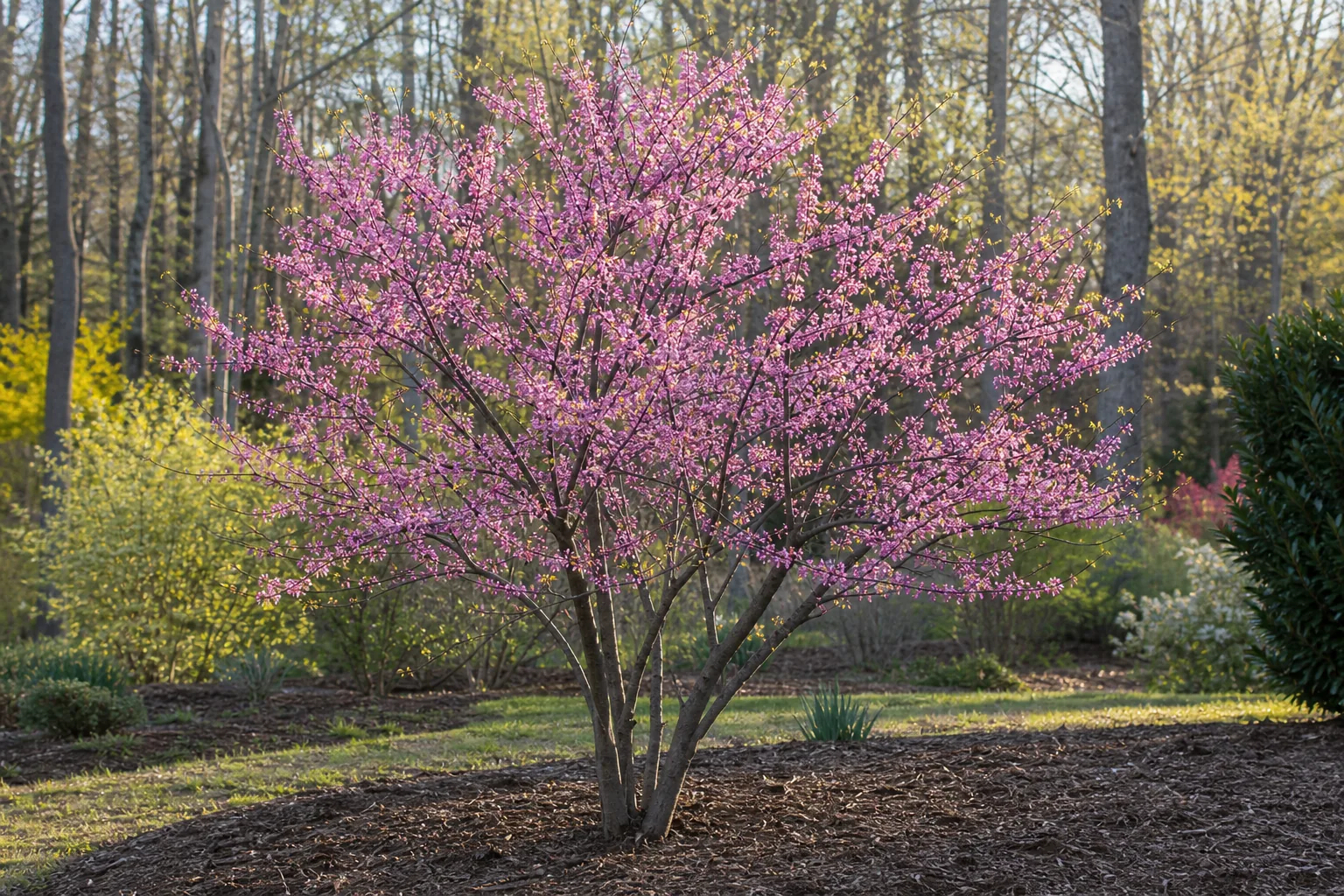
Plant Cercis canadensis while young because its roots resent later disturbance. Allow room for a low, rounded, sometimes multi-trunked crown, keep the root flare at grade, and maintain a broad mulch ring that does not touch the bark.
Light
Full sun supports the heaviest flowering in cooler regions, while partial or afternoon shade reduces heat stress in hot-summer climates. Avoid deep shade, where the crown becomes sparse and flowers decline.
Water
Maintain consistent moisture through establishment, then water during extended dry periods. Redbud prefers drainage and should not sit in persistently saturated soil; check the root ball separately after planting.
Soil and planting
Use moderately fertile, well-drained soil and disturb roots as little as possible. Plant at the same depth as the root flare and avoid later grade changes, trenching, or compaction beneath the crown.
Temperature, humidity, and fertilizer
Match local climate with a suitable regional provenance or cultivar and provide afternoon protection at the hot edge of its range. Fertilize only for a documented need; steady water and intact roots are more important than fast shoot growth.
Pruning and propagation
Select well-spaced permanent trunks early and remove crossing or damaged branches without stripping the natural form. Seed needs a hard-coat treatment followed by cold stratification; cuttings or grafting are used for selected forms.
Common problems
Start with the pattern, current soil moisture, and recent changes. One symptom can have several causes, so change the most likely factor first and observe before making another major adjustment.
| Symptom | Check first | First action |
|---|---|---|
| A branch wilts and develops a sunken lesion | Check the branch base and bark for a canker. | Prune affected wood back to healthy tissue in dry weather and disinfect tools. |
| Whole sections wilt despite moist soil | Check whether symptoms are one-sided and whether roots were disturbed. | Seek local diagnosis for wilt before replacing the tree in the same site. |
| Few spring flowers | Check tree age, direct light, and late frost exposure. | Improve light if practical and avoid nitrogen-heavy feeding. |
| Leaf edges scorch in midsummer | Check soil moisture, reflected heat, and afternoon exposure. | Water deeply and renew mulch without covering the trunk. |
| Young trunk forks weakly | Check for narrow included-bark unions. | Train a durable framework while branches are small. |
Pet and household safety
The reviewed botanical and horticultural sources did not provide a species-specific veterinary classification showing Eastern Redbud to be toxic or non-toxic to cats and dogs. Do not label it pet-safe; discourage chewing and contact a veterinarian after significant ingestion or concerning symptoms.
Frequently asked questions
How much sun does Eastern Redbud need?
Use full sun to partial shade, with afternoon shade favored in very hot summer regions.
How often should I water Eastern Redbud?
Keep a newly planted root ball consistently moist but drained, then water during sustained drought.
When does Eastern Redbud bloom?
Its rose-purple flowers appear on bare wood in early to mid-spring before the leaves.
Can I transplant an established Eastern Redbud?
It is difficult to transplant, so plant a young tree in its permanent position.
How do I propagate Eastern Redbud?
Species seed requires scarification and cold stratification; selected cultivars are propagated vegetatively.
Is Eastern Redbud safe for pets?
A species-specific authoritative veterinary classification was not found, so this profile does not claim pet safety.
Sources and editorial review
This editorial draft is based on the sources below and awaits named horticulture-expert approval before publication.
- Cercis canadensis L.Royal Botanic Gardens, Kew — Plants of the World Online · Checked
- Cercis canadensisNC State Extension · Checked
- Redbud — Cercis canadensisThe Morton Arboretum · Checked
- Cercis canadensisMissouri Botanical Garden · Checked
What works well
- Early spring flowers
- Fits smaller gardens
- Supports early-season wildlife
What to consider
- Does not transplant well
- Canker and wilt can occur
- Seed pods may persist