Key takeaways
- Give it bright light with some direct sun or bright indirect light - good light is required for flowering.
- Water moderately and allow the mix to become nearly dry between waterings.
- Do not remove the old flowering spur (peduncle) after bloom - new flowers form on it again.
How to care for Wax Plant
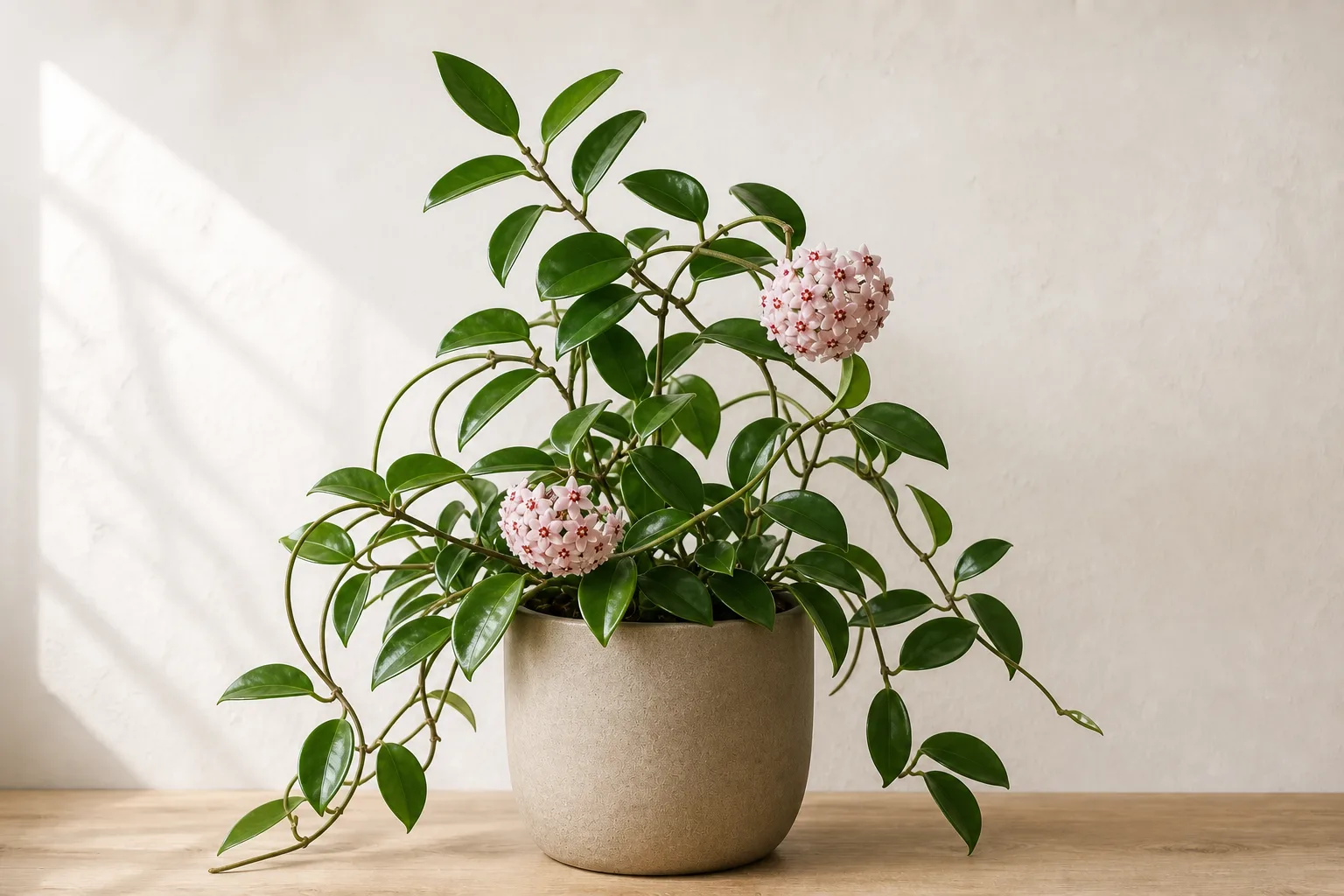
Wax plant (Hoya carnosa) is a climbing or trailing perennial of the dogbane and milkweed family (Apocynaceae), native from southern China and Japan to Taiwan, Laos, and Myanmar. In the wild it grows as an epiphyte or lithophyte, climbing counterclockwise around trees and rocks. Its thick, waxy, fleshy leaves store water, and it produces tight umbels of fragrant, star-shaped flowers with a distinctive red-centered corona.
Give it bright light with at least half a day of direct sun, or bright indirect light, in a loose, fast-draining mix, and let the soil become nearly dry between waterings. Most plants take two to three years to reach flowering age. Never cut the short flowering spur (peduncle) after bloom - new flowers form on that same spur in later seasons.
Light
Aim for bright light with at least half a day of direct sun - a sunny windowsill - or a spot with curtain-filtered sun and bright indirect light. Good light is necessary for flower production, and dim corners mean few or no flowers and slower growth. In winter, the plant needs less bright light. Rotate or move the plant with care once flower buds appear, since moving it can cause buds to drop.
Water
Water moderately but consistently through the growing season, allowing the soil to become nearly dry between water applications, then water thoroughly and drain. In winter, water less and let the mix dry further; the plant tolerates night temperatures to 50°F (10°C) during rest. Overwatering causes root rot, and using cold water can shock the plant, so use room-temperature water. A permanently wet pot is the most common cause of decline.
Soil and repotting
Use a loose, fast-draining potting mix with high organic matter - a standard loamy, well-drained mix works well - in a container with a drainage hole. The plant likes a somewhat snug pot and does well slightly root-bound, so repot only when the roots clearly fill the container, moving up one pot size in spring. Train the twining stems onto a trellis or let them trail from a hanging basket.
Temperature, humidity, and fertilizer
Wax plant prefers warmth and high humidity, with a minimum night temperature around 50-60°F (10-16°C) depending on the season, and it dislikes cold drafts. Average household humidity is workable, but higher humidity encourages more flowers. Feed with a balanced houseplant fertilizer during active growth in spring and summer, reducing or stopping in winter. Overfeeding can burn the roots, so dilute to label strength.
Pruning and propagation
Prune only lightly to shape the plant or remove dead growth, and never remove the flowering spurs - the same spur blooms again. Propagation is easy by stem cuttings: take a cutting with at least one node, allow the cut to callus, and root it in water or moist mix. Each cluster may include from 10 to 30 flowers, and the flowers may produce sticky nectar, so place the plant where drips are not a problem.
Common problems
Start with the pattern, current soil moisture, and recent changes. One symptom can have several causes, so change the most likely factor first and observe before making another major adjustment.
| Symptom | Check first | First action |
|---|---|---|
| Yellowing leaves or leaf drop | Root-zone moisture, drainage, and whether the pot sits in standing water | Pause watering and let the mix dry; check the roots if the mix has stayed wet. |
| No flowers | Available light, plant age, and whether old flowering spurs were accidentally removed | Move gradually to a brighter position and leave all peduncles in place; young plants simply need time. |
| Brown or scorched leaf patches | Recent direct sun, especially through glass, and sudden moves | Move the plant gradually to filtered light and let new leaves grow in. |
| Mealybugs or scale on stems and leaves | Leaf axils, undersides, and stem joints, and nearby plants | Isolate the plant and identify the pest before treating; wipe with a targeted control. |
| Soft, wrinkled stems or base | Whether the mix is wet or dry and recent temperature changes | Check the root zone first; water if dry, and unpot to inspect roots if the mix is still damp. |
Pet and household safety
Wax plant (Hoya carnosa) is non-toxic to cats and dogs. The ASPCA lists Wax Plant (Hoya carnosa) as non-toxic to cats and dogs, and NC State lists Hoya carnosa as non-toxic for cats, dogs, and horses. Still, 'non-toxic' does not mean edible - chewing any plant material can cause mild stomach upset in pets. Discourage chewing, keep the plant out of reach of curious pets, and contact a veterinarian if a pet seems unwell after eating any part of it.
Frequently asked questions
How often should I water a wax plant?
Water moderately and allow the mix to become nearly dry between waterings, then water thoroughly and drain. In winter, water less and let the mix dry further.
What light does a wax plant need?
Bright light with at least half a day of direct sun, or bright indirect light. Good light is necessary for flower production; dim rooms mean few or no flowers.
Where does wax plant grow naturally?
It is native from southern China and Japan to Taiwan, Laos, and Myanmar, where it grows as a climbing epiphyte or lithophyte in subtropical forests.
Why is my wax plant not flowering?
Usually not enough light, or the plant is still young - most take two to three years to reach flowering age. Make sure old flowering spurs were not pruned off, since new flowers form on them.
How do I propagate a wax plant?
Take a stem cutting with at least one node, let the cut callus, and root it in water or moist mix. Keep it warm and bright until roots form.
Is wax plant safe for pets?
Yes. The ASPCA lists Hoya carnosa as non-toxic to cats and dogs. Still discourage chewing, since any plant material can cause mild stomach upset.
Sources and editorial review
This editorial draft is based on the sources below and awaits named horticulture-expert approval before publication.
- Hoya carnosaRoyal Botanic Gardens, Kew (Plants of the World Online) · Checked
- Wax PlantASPCA · Checked
- Hoya carnosa (Wax Plant)North Carolina State University Extension · Checked
- Hoya carnosaMissouri Botanical Garden Plant Finder · Checked
What works well
- Long-lived and easy to grow; plants can flower for decades.
- Fragrant, waxy flower clusters in the warm season.
- Non-toxic to cats and dogs per the ASPCA.
What to consider
- Slow to reach flowering age - often two to three years or more.
- Overwatering causes root rot; a permanently wet pot is the main killer.
- Will not flower well in dim rooms.