Key takeaways
- Give it room: it climbs 30-50 ft by adhesive disks that can mark paint and masonry, and it also spreads as a ground cover.
- Prune, mow, or weed-whack in spring to control spread; it is drought tolerant and grows in full sun to full shade.
- The berries and plant parts contain oxalate crystals that are toxic if eaten, especially the berry-like fruits.
How to care for Virginia creeper
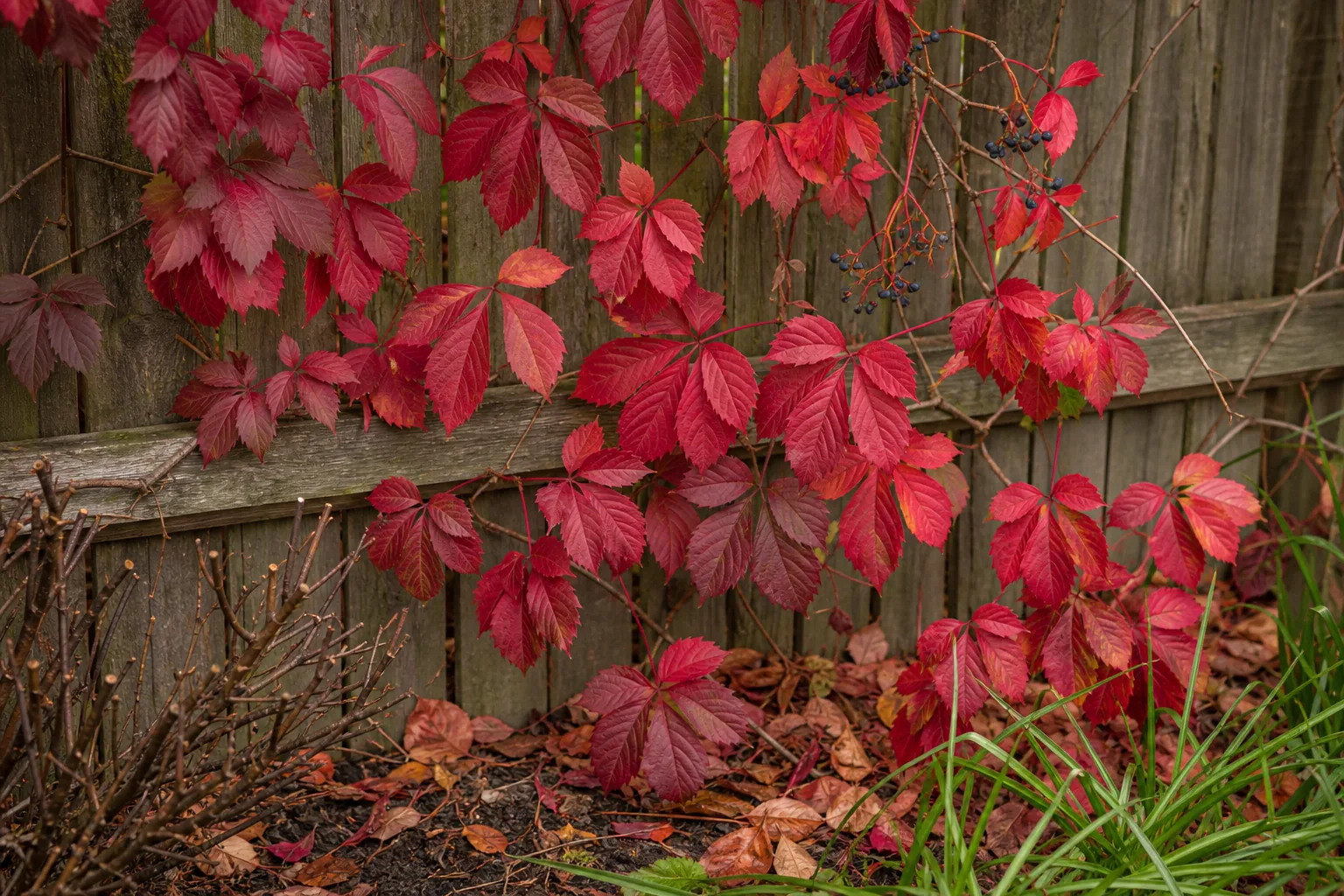
Virginia creeper (Parthenocissus quinquefolia) is a fast-growing, woody, deciduous vine that clings by adhesive disks at the tips of its tendrils and will climb 30-50 ft on walls, fences, trees, and rock faces, or sprawl as a ground cover. It is highly adaptable, growing in full sun to full shade and tolerating drought, salt, and poor soil. Water to establish, then it needs little. The main task is restraint: prune, mow, or weed-whack in spring to control spread, and do not grow it against wood or shingle walls, where the holdfasts are hard to remove and can ruin the paint.
Light
Virginia creeper grows in full sun to full shade, but it colors best in the fall and fruits best with at least some sun. Full sun gives the most brilliant red autumn foliage; heavy shade produces greener, less colorful growth but a healthy vine. It is one of the most shade-tolerant vines for a north wall.
Water
Water regularly through the first season to establish, then Virginia creeper is drought tolerant and needs little supplemental water in most climates. It tolerates occasional wet and dry conditions and grows well in average, well-drained soil. In prolonged drought, deep watering keeps growth healthy.
Soil and planting
Virginia creeper adapts to clay, loam, and sand with an acid-to-alkaline pH, and it tolerates compaction, pollution, and salt; average, well-drained soil is fine. In containers it is manageable with a sturdy support and a well-drained mix, watered more often than in-ground plants; repot in spring when rootbound.
Temperature, humidity, and fertilizer
Very hardy - USDA zones 3-9 (NC State lists 3a-10b) - Virginia creeper withstands cold, heat, and urban conditions. It has no serious pest or disease problems; occasional mildew, leaf spots, or beetles are minor. Fertilizer is rarely needed; a light spring feeding on poor soils is enough.
Pruning and propagation
Prune in spring to control size and shape; mowing or weed-whacking ground-cover growth keeps it in bounds, and cut it away from gutters, shutters, and wiring. Removing a mature vine from a wall is difficult - cut the stems and let the holdfasts weather off rather than prying. Propagate easily by hardwood or softwood cuttings, or by layering rooted stems.
Common problems
Start with the pattern, current soil moisture, and recent changes. One symptom can have several causes, so change the most likely factor first and observe before making another major adjustment.
| Symptom | Check first | First action |
|---|---|---|
| Vine pulls paint off the wall | Check whether holdfasts attached to a painted wood surface. | Cut the vine at the base and let the holdfasts dry and fall; avoid growing it on painted or shingle walls. |
| Berries eaten by pets or children | Check for the small blue-black berry clusters in late summer. | Remove berry clusters where accessible and call a veterinarian or poison control after any ingestion. |
| Vine smothering a tree or shrub | Check whether the vine has climbed into the crown. | Cut it at the base and pull the upper growth down before it shades the plant out. |
| Scorched or spotted leaves | Check for leaf spot, mildew, or leafhoppers in humid or stressed conditions. | Improve airflow, avoid overhead watering, and remove affected foliage. |
| Vine spreads where it is not wanted | Check for rooting stems and self-sown seedlings. | Mow or pull runners in spring and prune regularly to keep it where you want it. |
Pet and household safety
Virginia creeper contains calcium oxalate crystals in all parts, and NC State rates the species as a high-severity poison: eating the berries can cause nausea, abdominal pain, bloody vomiting, and diarrhea, and the berries are the most dangerous part for pets and children. It is not individually listed by ASPCA, but it is treated as toxic to cats and dogs - keep the berries out of reach and contact a veterinarian or poison control after ingestion.
Frequently asked questions
How much sun does Virginia creeper need?
Full sun to full shade; sun gives the best fall color.
How often should I water Virginia creeper?
To establish, then rarely - it is drought tolerant.
Is Virginia creeper the same as poison ivy?
No - it has five leaflets and no urushiol, but its berries are toxic if eaten.
How do I remove Virginia creeper from a wall?
Cut the stems at the base and wait for the holdfasts to dry and fall off.
Why is my Virginia creeper not turning red?
Usually too much shade; more sun produces the brilliant autumn color.
Is Virginia creeper safe for pets?
No - the berries contain oxalates and are toxic if eaten; keep them out of reach.
Sources and editorial review
This editorial draft is based on the sources below and awaits named horticulture-expert approval before publication.
- Parthenocissus quinquefoliaRoyal Botanic Gardens, Kew (Plants of the World Online) · Checked
- Toxic and Non-Toxic Plants ListASPCA · Checked
- Parthenocissus quinquefoliaNorth Carolina State University Extension · Checked
- Weed of the Month - Virginia CreeperClemson Cooperative Extension (HGIC) · Checked
What works well
- Spectacular crimson fall color and cover for walls, fences, slopes, and old stumps.
- Extremely adaptable: full sun to shade, drought tolerant, and resistant to salt and pollution.
- A native vine that provides food and shelter for birds, and it is not poison ivy (five leaflets, no urushiol).
What to consider
- Vigorous and weedy - it can overwhelm trees and buildings if not pruned.
- Holdfasts are hard to remove and can damage paint, stucco, and masonry.
- The berries and plant parts are toxic if eaten (oxalate crystals); the berries are the most dangerous.