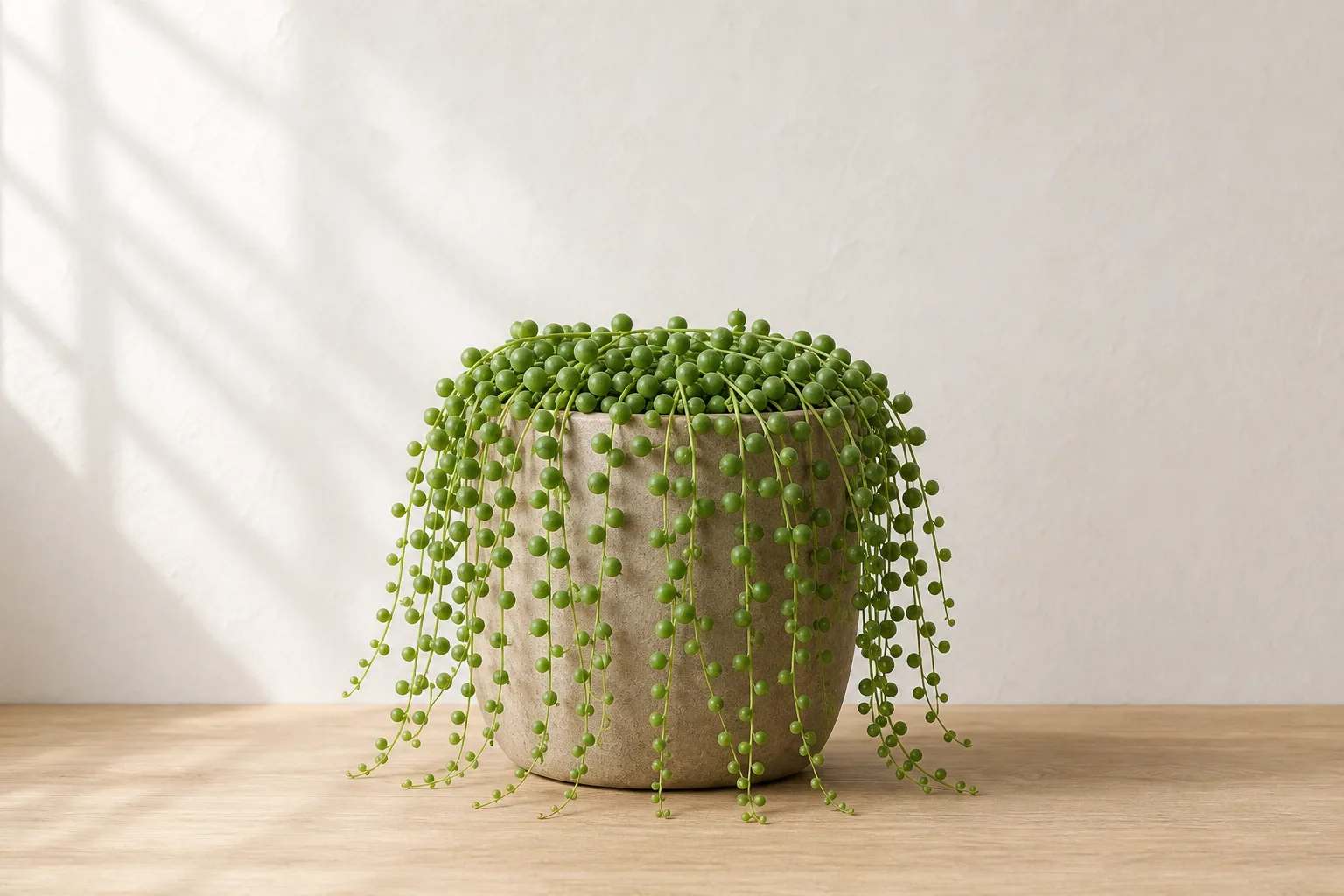
Key takeaways
- Give it bright indirect light; the pea-like leaves need plenty of light to stay plump and closely spaced.
- Water only after the mix has dried out - shriveled pearls can mean too much OR too little water, so check the roots first.
- Keep it out of reach of cats and dogs: the foliage is toxic if chewed.
How to care for String of Pearls
String of pearls (Curio rowleyanus) is a leafy succulent vine in the aster family (Asteraceae), native to the drier parts of southwest Africa. Its nearly spherical, pea-shaped leaves - each with a translucent 'window' that lets light reach the interior - store water and minimize evaporation, an adaptation to its arid home. The stems trail to 2 to 3 feet or more and root at nodes where they touch soil.
This is a plant that rewards patience and restraint. Give it bright filtered light, a dry, sandy, well-drained mix, and water only after the roots have dried out. Poorly drained or constantly moist soil leads to root rot, the most common failure, and shriveled pearls can indicate either over- or underwatering, so check the root zone before reacting.
Light
String of pearls grows best in full sun to part shade outdoors, and bright indirect light indoors - a bright windowsill is ideal. The spherical leaves reduce surface area for light, so the plant depends on its windows and needs a strong position to photosynthesize well. In too little light, growth stretches and the pearls become sparse and pale.
Water
Allow the roots to dry out between waterings, then water thoroughly and drain. The plant tolerates infrequent watering and withstands extended drought, but it is easily killed by poorly drained or persistently moist soil. Water less in winter, when growth slows. Because the pearls shrivel with both too much and too little water, always check the root zone and pot weight before watering.
Soil and repotting
Use a dry, sandy, well-drained cactus-type potting mix in a container with drainage holes. Repotting in spring every year or two keeps the plant refreshed, but note that plants tend to decline after several years - at that point it is often better to take cuttings and start over rather than revive the old plant. Choose a pot that lets the strands spill over the rim.
Temperature, humidity, and fertilizer
String of pearls does best in warm conditions - about 70-80°F (21-27°C) in summer and 50-60°F (10-15°C) in winter - and is unaffected by high humidity. It is intolerant of frost, so in cold climates bring it indoors before the first fall frost. Feeding is light: a diluted succulent fertilizer during active growth is enough, and none is needed in winter.
Pruning and propagation
Trim back overlong or dying strands to keep the plant looking full. Propagation is easy by stem cuttings: take a 3- to 5-inch section, bury several nodes in moist mix, and roots develop quickly where the leaves attach to the stem. Leaf cuttings root too, but more slowly. Renewing an aging plant from cuttings is the standard approach, since established plants eventually decline.
Common problems
Start with the pattern, current soil moisture, and recent changes. One symptom can have several causes, so change the most likely factor first and observe before making another major adjustment.
| Symptom | Check first | First action |
|---|---|---|
| Shriveled, flattened pearls | Root-zone moisture and whether the mix has dried out - both over- and underwatering cause this | Check the roots first; water only if the mix is dry, and let it drain if it is wet. |
| Blackened, mushy stems near the soil | Whether the mix has stayed wet and whether the pot drains | Withhold water, improve drainage, and take healthy stem cuttings before the rot spreads. |
| Sparse, stretched strands | Available light and how far the plant sits from the window | Move gradually to a brighter position and pinch strands back to encourage density. |
| Pearls turning yellow | Root moisture, drainage, and recent watering frequency | Let the mix dry out and confirm the pot drains before changing other conditions. |
| Aphids or mealybugs on stems | Stems, leaf joints, and nearby plants for pests | Isolate the plant and identify the pest before treating; use a targeted control. |
Pet and household safety
String of pearls (Curio rowleyanus) is toxic to cats and dogs if chewed. Its foliage contains pyrrolizidine alkaloids that can cause vomiting, diarrhea, and drooling, and contact with the sap can irritate skin. Keep the plant out of reach of pets and children who chew plants, wear gloves when handling, and contact a veterinarian or animal poison-control service after a concerning exposure.
Frequently asked questions
How often should I water a string of pearls?
Let the roots dry out between waterings, then water thoroughly and drain. The interval changes with light, pot size, and season, and should lengthen in winter. Check the root zone when the pearls shrivel.
What light does a string of pearls need?
Full sun to part shade outdoors, or bright indirect light indoors. In too little light the strands stretch and the pearls become sparse and pale.
Where does string of pearls grow naturally?
It is native to the drier parts of southwest Africa (Cape Provinces of South Africa), where its stems trail along the ground, rooting at the nodes to form a creeping ground cover.
Why are my pearls shriveling?
Both over- and underwatering cause shriveled pearls, so check the root zone first. Water only if the mix is dry; if it is wet, let it dry out before doing anything else.
How do I propagate a string of pearls?
Take a 3- to 5-inch stem section, bury several nodes in moist mix, and roots develop quickly. Leaf cuttings also root but grow more slowly.
Is string of pearls safe for pets?
No. It contains pyrrolizidine alkaloids and is toxic to cats and dogs if chewed. Keep it out of reach and contact a veterinarian after a concerning chew.
Sources and editorial review
This editorial draft is based on the sources below and awaits named horticulture-expert approval before publication.
- Curio rowleyanusRoyal Botanic Gardens, Kew (Plants of the World Online) · Checked
- Curio rowleyanus (String of Pearls)North Carolina State University Extension · Checked
- Curio rowleyanus (string of pearls)Missouri Botanical Garden Plant Finder · Checked
- Toxic and non-toxic plantsASPCA · Checked
What works well
- Unique, architectural trailing form made for a bright hanging basket.
- Tolerates infrequent watering and brief drought.
- Easily propagated from stem sections.
What to consider
- Picky about growing conditions - leaves shrivel with both over- and underwatering.
- Toxic to pets if chewed.
- Plants decline after several years and are best renewed from cuttings.