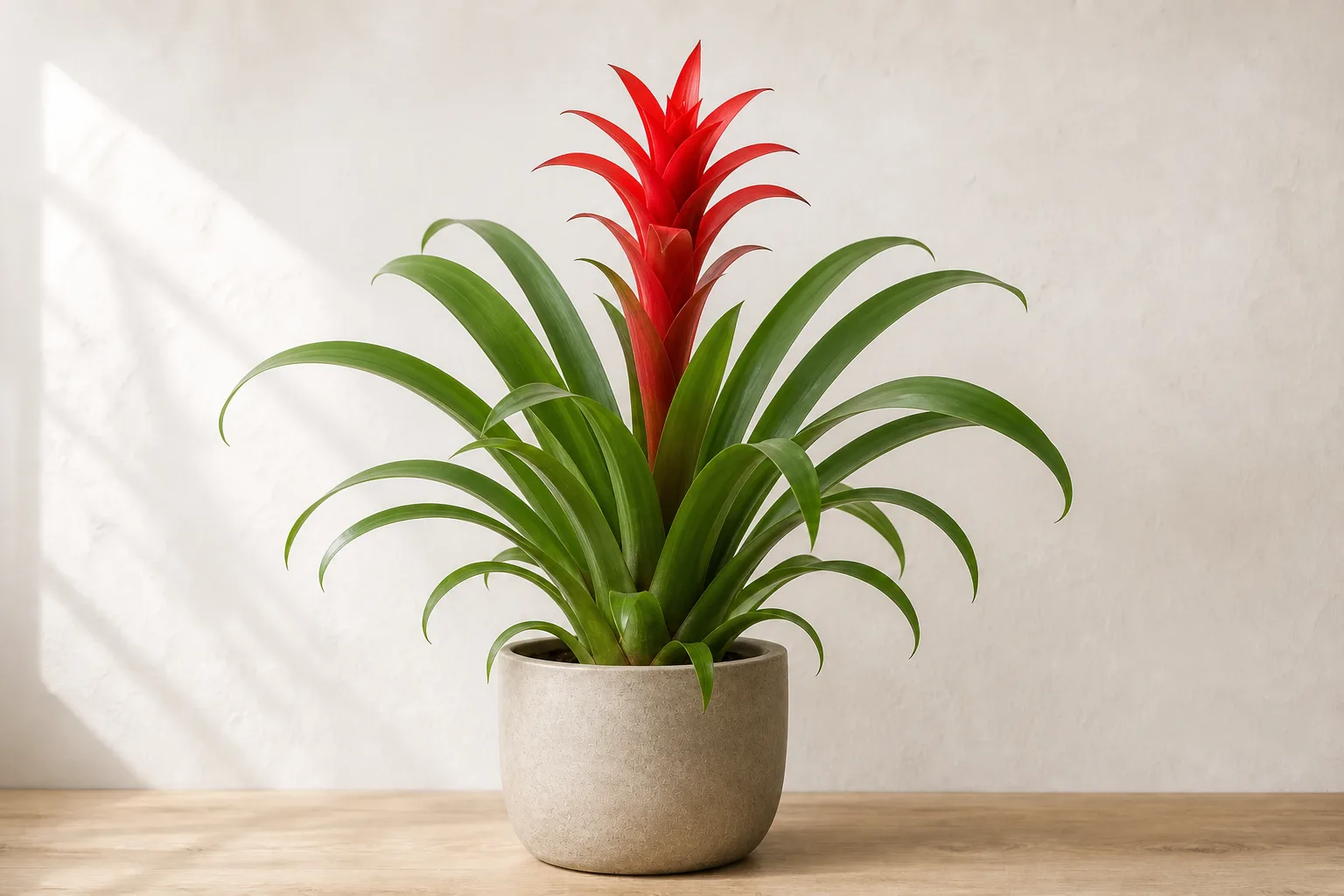
Key takeaways
- Give it part to full shade - it grows well under artificial light and in bright rooms set back from windows.
- Water sparingly at the roots and keep the central cup filled, especially in summer.
- After flowering the parent plant declines and produces offsets that can be potted on.
How to care for Scarlet Star
Scarlet star (Guzmania lingulata) is a tropical, epiphytic herbaceous perennial in the pineapple family (Bromeliaceae), native to rainforest habitats in tropical America and the West Indies. In the wild it clings to tree branches and rocks, drawing water and minerals from the air and from the central cup formed by its overlapping leaves. The name lingulata means 'tongue-shaped' and refers to the leaves.
It grows well in part to full shade and under artificial lights, which makes it unusually forgiving of indoor placement. Use a bromeliad or orchid potting mix, water sparingly at the roots, keep the center cup filled, and let air circulate around the roots. After flowering the main plant slowly declines and dies, but it produces offsets that grow into new plants.
Light
Aim for part shade to full shade. Scarlet star does well in dappled or deep shade and grows well under artificial light, which is rare among flowering houseplants. In a home, a spot set well back from a bright window or a north-facing position suits it. Avoid long periods of harsh direct sun, which can bleach or scorch the leaves, and move the plant gradually if you change its position.
Water
Water sparingly at the roots and let the mix approach dryness between waterings - Guzmania roots rot if kept wet. Keep water in the central cup of the rosette, especially in summer, and flush the cup occasionally so it does not stagnate. During cooler or winter months, keep the plant drier. Always use a container with drainage and never let the pot sit in a saucer of water.
Soil and repotting
Use a porous bromeliad or orchid mix - such as fine bark, perlite, and coir - in a pot with a drainage hole. The mix must drain quickly and allow air to reach the roots, since epiphytes are not adapted to dense, soggy soil. Repot only when the plant has outgrown its container, generally when you are removing offsets; keep the rosette at the surface and handle the shallow root system gently.
Temperature, humidity, and fertilizer
Scarlet star wants warm temperatures, with a minimum of about 60°F (16°C) at night, and prefers humid air. It grows well in greenhouses, bathrooms, and rooms with steady warmth. Feed with a diluted bromeliad fertilizer - at half strength or less - sprayed onto the foliage and the growing medium surface during the warm season. Too much fertilizer or fertilizer left sitting in the cup can burn the leaf bases.
Pruning and propagation
Pruning is limited to removing spent inflorescences and any dead outer leaves as the rosette ages. Propagation is by offsets, or pups, that form between the base leaves - wait until a pup has a few leaves and some roots, detach it cleanly, and pot it in bromeliad mix or attach it to wood. The parent plant dies back after flowering, so pups are the way the plant renews itself. Pups are slow and may not bloom for a couple of years.
Common problems
Start with the pattern, current soil moisture, and recent changes. One symptom can have several causes, so change the most likely factor first and observe before making another major adjustment.
| Symptom | Check first | First action |
|---|---|---|
| Soft, mushy leaf bases | Whether the mix is still wet, whether the pot drains, and how much water sits in the cup | Let the mix dry out, empty the cup, and check the roots before watering again. |
| Brown leaf tips | Low humidity, hard water, or fertilizer buildup in the cup | Raise local humidity and flush the central cup with fresh, ideally rainwater. |
| Faded or bleached leaves | Recent direct sun exposure and how close the plant sits to a bright window | Move the plant gradually to a shadier or set-back position. |
| Inflorescence fading early | Age of the bloom, temperature swings, and whether the plant has already flowered | Accept the natural bloom cycle; the rosette declines after flowering and pups replace it. |
| Scale, spider mites, or mealybugs on leaves | Leaf undersides and the central cup, and nearby plants | Isolate the plant and identify the pest before treating; wipe leaves and use a targeted control. |
Pet and household safety
Scarlet star (Guzmania lingulata) is non-toxic to cats, dogs, and horses. North Carolina State University classifies it as non-toxic for cats, dogs, and horses, and it is not listed in the ASPCA toxic plant database. Still, 'non-toxic' does not mean edible - any plant material can cause mild stomach upset if chewed, and the water held in the central cup can harbor bacteria or fertilizer residues. Discourage chewing, keep the plant out of reach of curious pets, and contact a veterinarian if a pet seems unwell after eating any part of it.
Frequently asked questions
How often should I water a scarlet star bromeliad?
Water sparingly at the roots and let the mix approach dryness between waterings, while keeping the central cup filled - especially in summer. Empty and refresh the cup regularly so the water does not stagnate.
What light does a scarlet star need?
Part shade to full shade, and it does well under artificial light. It prefers dappled or deep shade and can be set well back from a bright window without losing quality.
Where does scarlet star grow naturally?
It is native from southeastern Mexico through tropical America and the West Indies, where it grows as an epiphyte in rainforest, clinging to trees and rocks rather than soil.
Why are the leaves on my scarlet star turning brown at the tips?
Usually low humidity, hard tap water, or fertilizer residue in the cup. Raise local humidity and flush the cup with fresh water, then observe before changing anything else.
How do I propagate a scarlet star?
Remove offsets (pups) that form between the base leaves once they have a few leaves and some roots, and pot them in bromeliad mix. The parent rosette dies after flowering, so pups carry the plant on.
Is scarlet star safe for pets?
Yes. NC State lists it as non-toxic for cats, dogs, and horses, and it is not in the ASPCA toxic plant database. Still discourage chewing, since any plant material can cause mild stomach upset.
Sources and editorial review
This editorial draft is based on the sources below and awaits named horticulture-expert approval before publication.
- Guzmania lingulataRoyal Botanic Gardens, Kew (Plants of the World Online) · Checked
- Guzmania lingulata (Scarlet Star)North Carolina State University Extension · Checked
- Guzmania lingulataMissouri Botanical Garden Plant Finder · Checked
- Guzmania lingulata 'Red Brimstone' (Scarlet Star)Royal Horticultural Society · Checked
What works well
- Long-lasting, sculptural red-orange inflorescence that holds color for months.
- Non-toxic to cats, dogs, and horses.
- Tolerates lower and artificial light better than most flowering houseplants.
What to consider
- Monocarpic - the flowering rosette declines after bloom, though it leaves offsets.
- Slow-growing; offsets take years to reach bloom size.
- Root rots quickly if the potting mix stays soggy.