Key takeaways
- Heat-loving vine that grows through hot summers when true spinach bolts; frost tender.
- Plant in full sun in fertile, moist but well-drained soil; soak or scarify seeds first.
- Harvest young leaves and shoots regularly; flowering (from dryness or short days) turns leaves bitter.
How to care for Malabar spinach
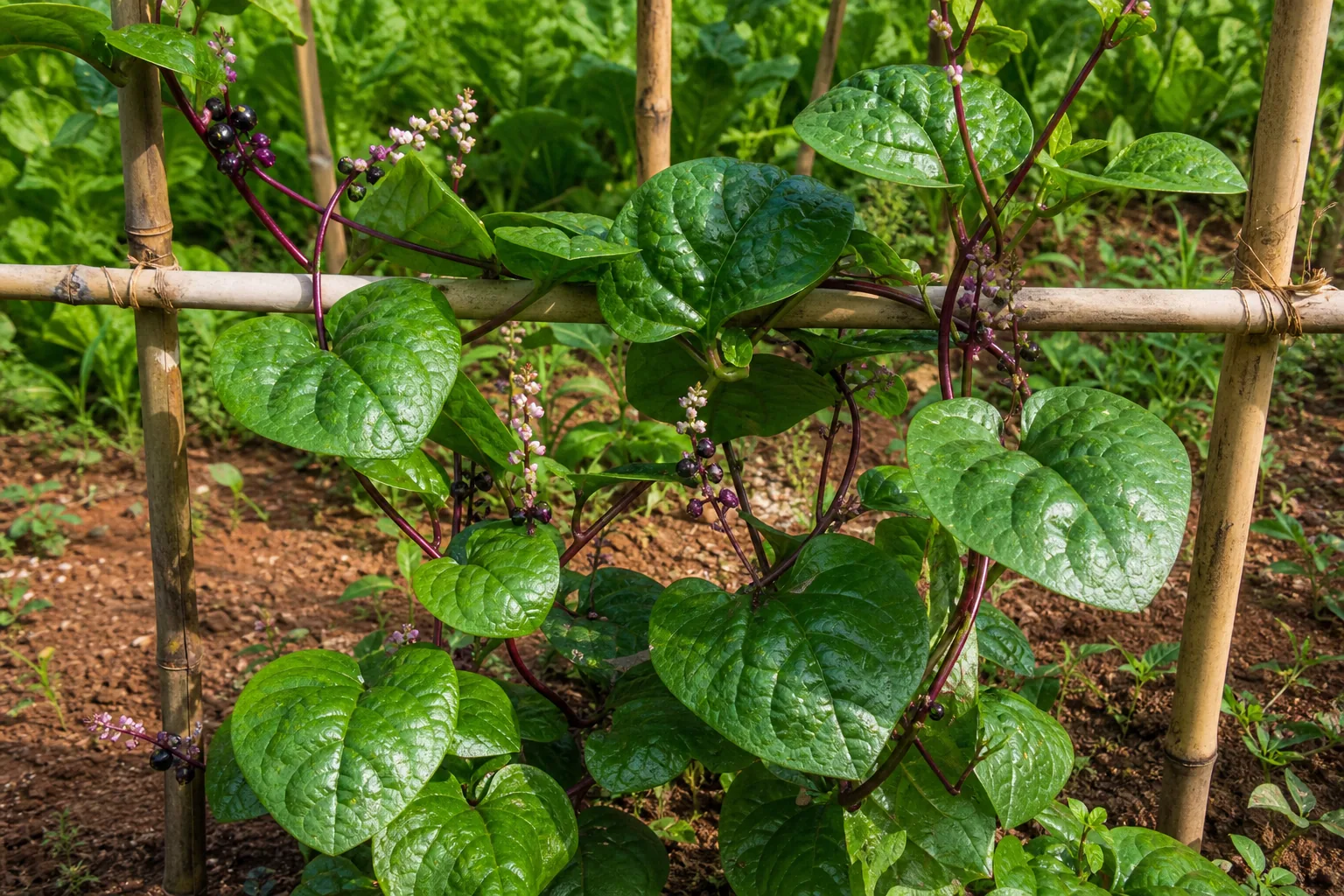
Malabar spinach (Basella alba) is a heat-loving twining vine that takes over the summer garden. Plant it after all frost danger in full sun (a little afternoon shade in hot regions), in fertile, moisture-retentive, well-drained soil, and give the vigorous stems a trellis, fence, or stakes. Seeds are slow to germinate - soak them overnight or scarify them to speed things up. Keep the soil consistently moist; dry soil triggers flowering, and once the plant flowers the leaves turn bitter. Harvest tender young leaves and shoots often to keep the vine productive.
Light
Malabar spinach grows best in full sun (6 or more hours of direct light); partial shade in very hot climates is fine and can give larger, more tender leaves. Heavy shade slows growth and reduces the harvest.
Water
Keep the soil consistently moist - this is the single most important watering rule, because drought stress makes the plant flower and the leaves bitter. Water deeply in dry weather and mulch to hold moisture, but avoid waterlogged ground.
Soil and planting
Grow in fertile, moisture-retentive but well-drained soil rich in organic matter, with a pH of roughly 5.5-7.0. In containers use a large pot with a trellis and a rich, free-draining mix, and water more often than in-ground plants. Plant out at least a foot apart once the soil has warmed.
Temperature, humidity, and fertilizer
Malabar spinach is a frost-tender perennial (hardy only to about zone 10) grown as a warm-season annual; it does its best above 80 F and stops growing when nights stay below 60 F. It loves heat and humidity. Fertile soil usually provides enough nutrition; a light balanced feed in midseason helps sustained leaf production, and avoid excess nitrogen that softens the growth.
Pruning and propagation
Harvest regularly - pinch or cut the tender growing tips and leaves - which keeps the vine bushy and productive. Cut back overlong vines to encourage new growth. Propagate by seed (soak or scarify; germination takes 10 days to 3 weeks) or from stem cuttings, which root readily in water or moist soil; stems also root where they touch the ground.
Common problems
Start with the pattern, current soil moisture, and recent changes. One symptom can have several causes, so change the most likely factor first and observe before making another major adjustment.
| Symptom | Check first | First action |
|---|---|---|
| Plant flowers and leaves turn bitter | Check for dry soil or shortening days. | Water consistently to suppress flowering and cut the plant back to encourage new, sweet leaves. |
| Seedlings are slow or fail to appear | Check seed treatment and soil warmth. | Soak or scarify seeds and sow in warm soil (65-75 F); germination takes 2-3 weeks. |
| Yellowing leaves or stunted growth | Check soil moisture and nutrition in containers. | Water consistently, feed lightly, and ensure good drainage. |
| Spots or blotches on leaves | Check for fungal leaf spot (Cercospora) in humid conditions. | Remove affected leaves, improve airflow, and avoid overhead watering. |
| Vines tangle and smother the support | Check growth - Malabar spinach can reach 10-30 feet. | Harvest and prune aggressively; train stems onto a sturdy trellis and cut back excess. |
Pet and household safety
Malabar spinach (Basella alba) is non-toxic to cats and dogs. NC State Extension's profile lists no poison characteristics, the plant is a widely eaten leafy vegetable, and the ASPCA's toxic and non-toxic plant list carries no Malabar spinach species page or toxicity warning. The leaves and young shoots are edible for people, so pets that nibble are generally fine, though eating large amounts of any plant can cause mild stomach upset. Note that the deep purple-black berries can stain, so keep them off carpets and light-colored surfaces.
Frequently asked questions
Is Malabar spinach really spinach?
No - it is an unrelated vine (family Basellaceae) grown like spinach; its thick leaves are used the same way but tolerate heat that kills true spinach.
When do I plant Malabar spinach?
After the last frost, once soil reaches about 65-75 F; start seeds indoors 6-8 weeks early in cool climates.
Why are my Malabar spinach leaves bitter?
Usually the plant has started flowering, triggered by dry soil or shortening days. Water consistently and cut the plant back for fresh growth.
How big does Malabar spinach grow?
As an annual the twining vine typically reaches 3-10 feet and can climb 30 feet in ideal tropical conditions.
Can I grow it in a container?
Yes - a large pot with a trellis, rich free-draining mix, and consistent watering works well.
Is Malabar spinach safe for pets?
Yes - it is non-toxic to cats and dogs and the leaves are edible; discourage heavy chewing and keep the staining berries in mind.
Sources and editorial review
This editorial draft is based on the sources below and awaits named horticulture-expert approval before publication.
- Basella albaRoyal Botanic Gardens, Kew (Plants of the World Online) · Checked
- Toxic and Non-Toxic Plants listASPCA · Checked
- Basella alba (Malabar Spinach)North Carolina State University Extension · Checked
- Florida Cultivation Guide for Malabar Spinach (HS1371)University of Florida IFAS Extension (EDIS) · Checked
What works well
- Provides fresh leafy greens through summer heat, with a mild citrus-peppery flavor.
- Very fast, attractive twining vine for trellises, fences, and large containers.
- Non-toxic and edible; few serious pest or disease problems.
What to consider
- Frost tender - grows as an annual outside tropical zones.
- Slow to start; needs warm soil (65-75 F) and grows little until heat arrives.
- Mucilaginous texture when cooked (like okra); some people dislike it.