Key takeaways
- Give it the brightest spot you have - stretched growth means it is not getting enough light.
- Water only during the growing season and keep it dry while the old leaf pair is being replaced.
- Use a gritty, mineral mix and a deep pot, because the roots reach farther than the tiny body suggests.
How to care for Living Stone
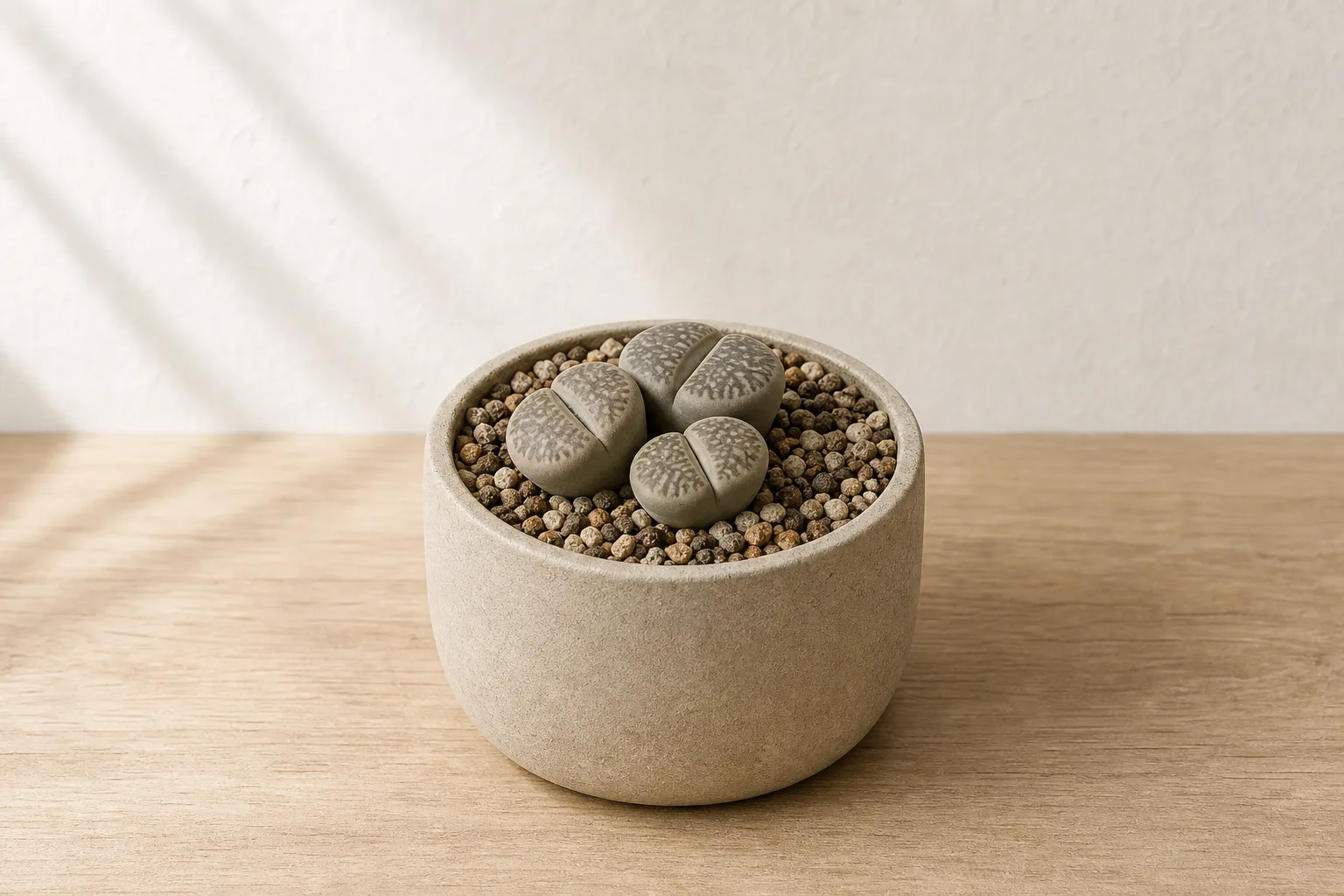
Living stone (Lithops karasmontana) is a dwarf mesemb from the Aizoaceae family, native to Namibia where it grows among quartzite gravel in the Great Karas Mountains. Each plant is a pair of thick, fused leaves whose patterned top sits at soil level, an adaptation that hides it from grazing animals. It grows on an annual cycle: a new leaf pair emerges from the fissure, the old pair shrivels away, and flowers push up between the leaves in autumn.
Care is about matching that cycle. Give it maximum light and a gritty, mineral mix, and water only at the right stages - in growth, and never while the old leaves are being replaced. Overwatering is the fastest way to kill a living stone, so restraint is the core skill.
Light
Living stones need as much sunlight as possible indoors - a south-facing windowsill or bright grow light is ideal. In their native quartz fields they are exposed to intense sun. If the plant stretches upward or grows taller and paler, it is not getting enough light; move it gradually into a stronger position. Watch for the body's color and firmness as feedback rather than following a fixed schedule.
Water
Watering is seasonal and species-specific. In general, water deeply during the autumn growing and flowering period, then stop for winter while the old leaf pair shrivels and the new pair develops. Resume light watering in spring as growth begins, then withhold water through the summer rest. Never water while the old leaves are being absorbed - moisture then makes the body split or rot. In a cool, dim indoor winter, the plant may need almost no water for months.
Soil and repotting
Use an extremely well-drained, gritty, mineral-based mix - a commercial cactus mix is often too rich, so amend it generously with coarse grit, pumice, or perlite. Choose a pot at least 3 to 4 inches deep, because the taproot reaches far below the visible body, and make sure it has a drainage hole. Repot only when there is a cultural problem such as soggy soil or when the plant has clearly outgrown its container, which happens only every several years.
Temperature, humidity, and fertilizer
Living stones prefer warm, dry conditions with strong light and good airflow; they do not need extra humidity and should not be misted. They tolerate considerable heat when air moves freely but must be protected from frost and from cold, wet winters. Fertilizer is generally unnecessary - these plants are adapted to nutrient-poor mineral soil, and feeding can disrupt their careful growth cycle.
Pruning and propagation
There is little to prune on a living stone - the old leaf pair shrivels and dries on its own each year, and you can brush away the papery remains once the new pair has fully emerged. Do not pull at the old leaves before they have dried. Propagation is by seed, which is slow and requires patience; plants can also form clumps over many years. Never repot or divide a plant that is actively splitting.
Common problems
Start with the pattern, current soil moisture, and recent changes. One symptom can have several causes, so change the most likely factor first and observe before making another major adjustment.
| Symptom | Check first | First action |
|---|---|---|
| Body stretching upward | Available light and how far the plant sits from the window | Move it gradually to the brightest position available; the stretched growth will not correct itself. |
| Splitting or bursting of the body | Recent watering during the rest phase, or water in the fissure | Stop watering entirely until the new leaf pair has fully emerged and the old pair has dried. |
| Soft, mushy body | Whether the mix has stayed wet and whether the pot drains | Withhold water, check the roots for rot, and repot in fresh, gritty mix only if needed. |
| Old leaves not shriveling | Whether the plant was watered while replacing leaves and the temperature | Keep the plant dry and warm until the old pair dries out; do not peel it off early. |
| Fine webbing or stippling | Leaf surfaces and mix for spider mites or mealybugs, and nearby plants | Isolate the plant and identify the pest before treating; keep the plant dry and well ventilated. |
Pet and household safety
Living stone (Lithops karasmontana) is commonly listed as non-toxic to cats and dogs. Non-toxic does not mean edible: chewing any plant or potting material can still upset a pet's stomach, so discourage persistent chewers and contact a veterinarian if a pet becomes unwell. The plant is tiny and sits low in its pot, so place it where it will not be knocked over by curious pets.
Frequently asked questions
How often should I water a living stone?
Water only during the growth cycle - typically in autumn as it grows and flowers, and lightly again in spring. Keep it dry through the winter leaf-replacement and the summer rest. When in doubt, wait.
What light does a living stone need?
As much sun as possible - a south-facing windowsill or grow light. Stretched, paler growth means insufficient light; move it gradually to a stronger position.
Where does living stone grow naturally?
Lithops karasmontana is native to the Great Karas Mountains of southern Namibia, where it grows among quartzite gravel in a region that receives very little rainfall.
Why is my living stone splitting open?
Most often watering while the old leaf pair is being replaced, which makes the body take up water at the wrong time. Keep it dry until the new pair has fully emerged.
How do I propagate a living stone?
Living stones are propagated by seed, which is slow and requires patience. Mature plants may slowly form clumps that can be divided, but never disturb a plant that is actively splitting.
Is living stone safe for pets?
It is commonly listed as non-toxic to cats and dogs. Non-toxic does not mean edible, so still discourage chewing and contact a veterinarian if a pet becomes unwell.
Sources and editorial review
This editorial draft is based on the sources below and awaits named horticulture-expert approval before publication.
- Lithops karasmontanaRoyal Botanic Gardens, Kew (Plants of the World Online) · Checked
- Lithops (Living Stones)North Carolina State University Extension · Checked
- Lithops karasmontana (Karas Mountains living stone)Royal Horticultural Society · Checked
- Toxic and non-toxic plantsASPCA · Checked
What works well
- A genuinely unusual plant with striking stone-mimicking patterns.
- Very slow, compact, and long-lived in the right conditions.
- Commonly listed as non-toxic to cats and dogs.
What to consider
- Demanding watering cycle - the leading cause of failure is water at the wrong time.
- Grows so slowly that mistakes take a long time to correct.
- One leaf pair at a time makes it a quiet, occasional plant.