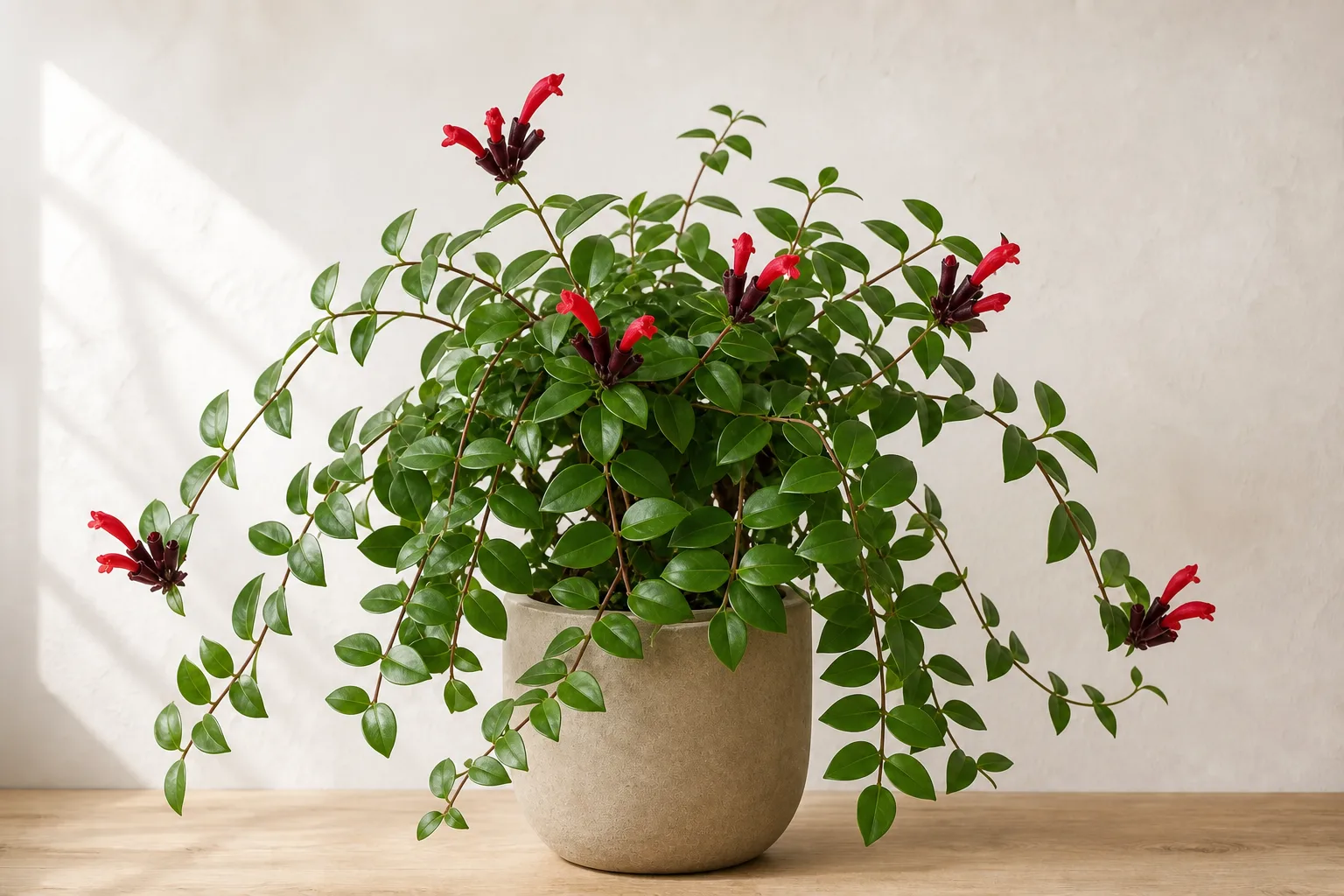
Key takeaways
- Give it bright indirect light - not full sun - and steady warmth for the most reliable flowering.
- Water regularly with good drainage; it is a thirsty plant that dislikes a soggy or bone-dry pot.
- Take three-node stem cuttings in spring; roots usually appear within about two weeks.
How to care for Lipstick Plant
Lipstick plant (Aeschynanthus radicans) is a tropical, evergreen, epiphytic herbaceous perennial native to Thailand, the Malay Peninsula, Sumatra, and Borneo, where it grows on tree branches. Its genus name comes from the Greek for 'shame flower,' referring to its blushing red flowers; the species name means 'rooting.' The common name comes from the flower buds, which resemble tubes of lipstick before the scarlet flowers open.
Give it bright indirect light (not full sun) and warmth, keeping soil temperatures around 65-70°F (18-21°C) during the growing season, with high humidity and good air circulation. Water often but make sure the potting mix drains well. In winter, keep it a bit cooler and drier; if the temperature falls below 50°F (10°C), the leaves will drop.
Light
Aim for bright indirect light, and avoid full sun. A position near an east window, or a few feet back from a south or west window, gives the plant the light it needs to flower freely. It does well under artificial light too. Too little light reduces flowering and stretches the growth; harsh direct sun can scorch the waxy leaves.
Water
Water regularly through the growing season, keeping the potting mix moist but never soggy, and use tepid water. Good drainage is essential - the plant is thirsty, especially in hanging baskets, but roots rot in standing water. In winter, keep it somewhat cooler and drier, which also helps set buds. Leaf drop usually signals either a draft or improper watering.
Soil and repotting
Use an open, well-drained mix high in organic matter - an African violet mix with added crushed charcoal or perlite works well - in a pot with a drainage hole. These epiphytes appreciate a mix that holds moisture without staying wet. Repot in spring when the plant is clearly root-bound, moving up one pot size and handling the brittle stems gently.
Temperature, humidity, and fertilizer
Lipstick plant prefers warmth - about 65-70°F (18-21°C) during the growing season - and high humidity with air circulation, since stagnant moist air encourages fungal disease. During winter rest, keep it slightly cooler and drier, which encourages bud formation for new flowers. Feed with a dilute liquid fertilizer, such as one made for orchids, during the growing season to encourage leaf growth and blooming.
Pruning and propagation
After flowering, prune stems back to about 6 inches to encourage new growth, and pinch leggy stems to keep the plant full. Propagation is easy: take a three-node soft stem cutting, remove all but the uppermost two to four leaves, dip the cut end in rooting hormone if you like, and pot it in a moist mix of equal parts vermiculite and perlite - roots usually appear within about two weeks.
Common problems
Start with the pattern, current soil moisture, and recent changes. One symptom can have several causes, so change the most likely factor first and observe before making another major adjustment.
| Symptom | Check first | First action |
|---|---|---|
| Leaf drop | Recent cold drafts, temperatures below 50°F, and root-zone moisture | Move the plant to a warm, draft-free spot and check whether the mix is too wet or too dry. |
| Few or no flowers | Available light, plant age, and whether the plant gets a cooler, drier rest in winter | Move gradually to brighter filtered light and allow a slightly cooler, drier winter period for bud set. |
| Brown, crispy leaf edges | Low humidity, dry air from vents, and uneven watering | Raise local humidity, even out watering, and move the plant away from dry vents. |
| Fungal spots on leaves | Stagnant air, wet leaves, and whether foliage touches the potting medium | Improve air circulation, keep leaves dry, and remove affected foliage. |
| Mealybugs or aphids on new growth | Leaf undersides, flower buds, and stem joints | Isolate the plant and identify the pest before treating; use a targeted control. |
Pet and household safety
Lipstick plant (Aeschynanthus radicans) is non-toxic to cats and dogs. The ASPCA lists Lipstick Plant as non-toxic to cats, dogs, and horses, and NC State lists Aeschynanthus radicans with no toxicity flags for pets. Still, 'non-toxic' does not mean edible - chewing any plant material can cause mild stomach upset in pets. Discourage chewing, keep the plant out of reach of curious pets, and contact a veterinarian if a pet seems unwell after eating any part of it.
Frequently asked questions
How often should I water a lipstick plant?
Water regularly through the growing season, keeping the mix moist but never soggy, and use tepid water. It is a thirsty plant, especially in hanging baskets, but the pot must drain well.
What light does a lipstick plant need?
Bright indirect light - not full sun. An east window or a spot set back from a south or west window gives it the light it needs to flower freely.
Where does lipstick plant grow naturally?
It is native to Thailand, the Malay Peninsula, Sumatra, and Borneo, where it grows as an epiphyte on tree branches in humid tropical forests.
Why is my lipstick plant dropping its leaves?
Usually a cold draft, temperatures below 50°F (10°C), or improper watering. Move it to a warm, stable spot and check the root zone before changing anything else.
How do I propagate a lipstick plant?
Take a three-node soft stem cutting, remove all but the uppermost two to four leaves, and root it in a moist mix of equal parts vermiculite and perlite - roots usually appear in about two weeks.
Is lipstick plant safe for pets?
Yes. The ASPCA lists it as non-toxic to cats and dogs. Still discourage chewing, since any plant material can cause mild stomach upset.
Sources and editorial review
This editorial draft is based on the sources below and awaits named horticulture-expert approval before publication.
- Aeschynanthus radicansRoyal Botanic Gardens, Kew (Plants of the World Online) · Checked
- Lipstick PlantASPCA · Checked
- Aeschynanthus radicans (Lipstick Plant)North Carolina State University Extension · Checked
- Aeschynanthus radicans (Lipstick Plant)Missouri Botanical Garden Plant Finder · Checked
What works well
- Unusual and showy lipstick-shaped buds that open to scarlet tubular flowers.
- Ideal trailing habit for hanging baskets.
- Easy to propagate from stem cuttings.
What to consider
- Drops leaves below 50°F (10°C) or in cold drafts.
- Needs bright light and warmth to flower well.
- Stagnant, moist air encourages fungal disease.