Key takeaways
- Give it bright indirect light to full sun; a south or west window is ideal.
- Water deeply only when the mix is completely dry, and much less in winter.
- Keep it away from cats and dogs - it is toxic if chewed.
How to care for Jade Plant
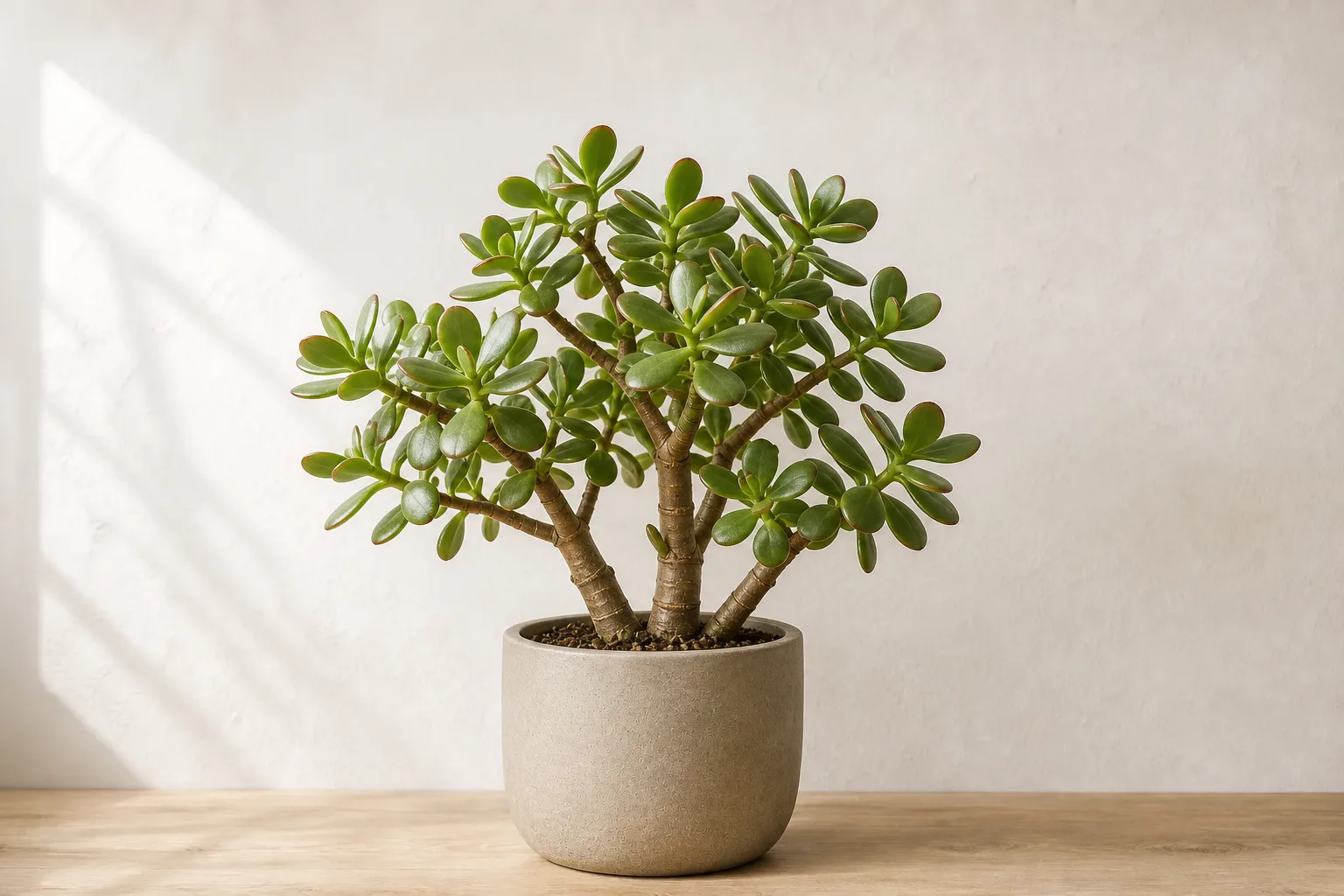
The jade plant (Crassula ovata) is a branched succulent from the dry scrub of South Africa and Mozambique, where it grows into a shrub that can reach several feet. Indoors it develops the look of a miniature tree: thick, fleshy, glossy oval leaves on stout stems that slowly thicken into a trunk-like base. It is one of the most popular succulents in cultivation, in part because it lives for decades when given the right window and watering habit.
Jade's two rules are light and drainage. It wants the brightest spot in the home - several hours of direct sun when possible - and a porous mix that dries out fully between waterings. In bright light the leaf edges may flush red, which is a sign of a happy plant. The most common indoor failure is overwatering in dim light, which leads to soft leaves and root rot. It is toxic to cats and dogs, so place it out of reach.
Light
Jade plant does best in bright indirect light to full sun - a south or west window is ideal. Give it as much direct sun as the window provides, especially in winter, and it will stay compact with leaves held tightly along the stems. In too little light, stems stretch, leaves drop, and the plant becomes weak and top-heavy. If a jade has been in a dim spot, move it into stronger light gradually to avoid scorching the leaves.
Water
Water thoroughly only when the mix has dried out completely, then let all excess drain and empty the saucer. In a bright room that often means every two to three weeks, and much less in winter. The plant stores water in its leaves and stems, so a dry spell is always safer than extra water. Leaves that become soft, wrinkled, or slightly flattened usually mean the plant needs water; leaves that turn yellow or drop usually mean too much water or too little light.
Soil and repotting
Use a fast-draining cactus or succulent mix, often improved with extra perlite or coarse sand, in a pot with a drainage hole. Terracotta pots help the mix dry evenly. Repot in spring when roots fill the pot, usually every two to three years, and go up only one pot size - an oversized pot holds moisture that can rot the roots. After repotting, wait several days before watering so any damaged roots can heal.
Temperature, humidity, and fertilizer
Jade plant prefers warm days and cool-to-average rooms (roughly 55-80°F / 13-27°C) and tolerates dry indoor air well. It is not frost-tolerant and should stay above about 45°F (7°C). Feed sparingly during spring and summer with a balanced or succulent fertilizer at half strength, and skip feeding in fall and winter, when a cooler, drier rest period supports healthy growth and even flowering in mature plants.
Pruning and propagation
Prune jade in spring or summer to shape the plant: cut stems just above a leaf pair and the plant will branch from that point. Remove any soft, damaged, or crossing stems with clean tools. Propagation is easy from stem or leaf cuttings - let the cut end dry and callus for several days, then root it in dry cactus mix. Leaf cuttings root more slowly than stem cuttings, but both work.
Common problems
Start with the pattern, current soil moisture, and recent changes. One symptom can have several causes, so change the most likely factor first and observe before making another major adjustment.
| Symptom | Check first | First action |
|---|---|---|
| Soft, wrinkled, or drooping leaves | Whether the mix is bone-dry or wet and the health of the roots | Check the root zone first; water deeply only if dry, and inspect for rot if the mix is wet. |
| Yellowing or dropping leaves | Watering frequency, pot drainage, and recent light changes | Reduce watering, confirm drainage, and move gradually to brighter light. |
| Leggy, stretched stems | Available light and distance from the window | Move gradually to stronger light and prune leggy stems back to a leaf pair. |
| Red-brown or shriveled patches on leaves | Recent sun exposure and water stress | Adjust light gradually and steady the watering routine before changing anything else. |
| White cottony insects or sticky residue | Stems, leaf joints, and undersides for mealybugs | Isolate the plant, remove visible pests, and treat with a targeted control. |
Pet and household safety
Jade plant (Crassula ovata) is toxic to cats, dogs, and horses if chewed. The ASPCA lists it as toxic with an unknown toxic principle and reports clinical signs of vomiting, depression, and incoordination. Keep the plant out of reach of pets and children who chew plants, and contact a veterinarian or animal poison-control service after a concerning exposure.
Frequently asked questions
How often should I water a jade plant?
Only when the mix is completely dry - often every two to three weeks in a bright room and much less in winter. Jade stores water in its leaves and stems, so dryness is safer than extra water.
What light does a jade plant need?
Bright indirect light to full sun; a south or west window is ideal. Strong light keeps growth compact and can redden the leaf edges; dim light causes stretching and leaf drop.
How big does a jade plant grow indoors?
Indoors it usually stays between about 1 and 3 feet, slowly developing a thick, trunk-like stem. With decades of good care it can grow much larger.
Why are the leaves falling off?
Usually overwatering, too little light, or a sudden change in conditions. Check the root zone, steady the watering routine, and move the plant gradually toward brighter light.
How do I propagate a jade plant?
From stem or leaf cuttings. Let the cut end dry and callus for several days, then root it in dry cactus mix. Stem cuttings establish faster than single leaves.
Is a jade plant safe for pets?
No. It is toxic to cats and dogs if chewed, with vomiting, depression, and incoordination reported. Keep it out of reach and contact a veterinarian after a concerning chew.
Sources and editorial review
This editorial draft is based on the sources below and awaits named horticulture-expert approval before publication.
- Crassula ovataRoyal Botanic Gardens, Kew (Plants of the World Online) · Checked
- Jade PlantASPCA · Checked
- Crassula ovataNorth Carolina State University Extension · Checked
- Crassula ovataMissouri Botanical Garden · Checked
What works well
- Lives for decades and develops a distinctive trunk-like form.
- Very tolerant of dry indoor air and occasional neglect.
- Propagates easily from stem or leaf cuttings.
What to consider
- Toxic to cats and dogs if chewed.
- Rot follows overwatering, especially in dim light.
- Grows slowly and drops leaves if light is too low.