Key takeaways
- Plant both a male and a female vine (about 1 male to every 6-10 females) for fruit; 'Issai' is the main self-fertile cultivar.
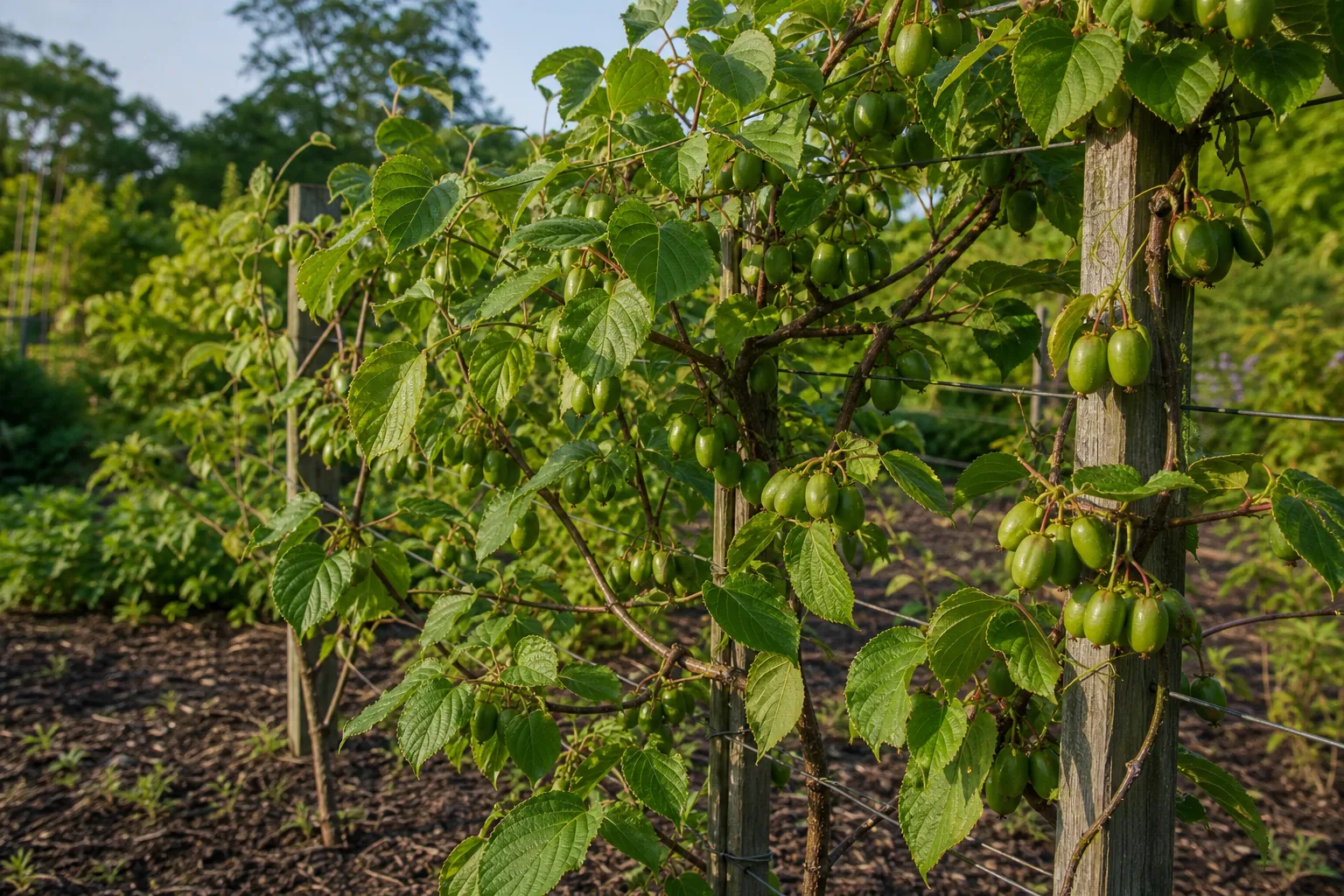
- Provide a stout trellis, arbor, or pergola - a single vine can grow 25-30 feet in a season and carry a heavy crop.
- Prune in late winter, cutting most of last year's growth back to 8-10 buds per stem; fruit forms on the current season's shoots.
How to care for hardy kiwi
Hardy kiwi (Actinidia arguta) is a vigorous twining vine that needs strong support from day one - a stout arbor, T-bar, or pergola, because a mature plant can grow 25-30 feet and carry a heavy crop. It is dioecious, so plant a male pollinizer for every 6-10 female vines with overlapping bloom time; the self-fertile 'Issai' is the exception. Site vines in full sun to light shade with fertile, well-drained, moisture-retentive soil, and mulch to keep roots cool and moist. Be patient: vines typically take a few years to establish and may not fruit heavily until year 5-7.
Light
Hardy kiwi fruits best in full sun (6 or more hours of direct light). In hot regions light afternoon shade is tolerated, but too much shade reduces flowering and fruit quality. Full sun also keeps the dense canopy drier and less prone to foliar disease.
Water
Keep the root zone consistently moist through the growing season; young vines and swelling fruit do poorly when dry. Hardy kiwi tolerates brief drought once established, but deep, regular watering during establishment and while fruit is sizing gives the best crops. Avoid waterlogged ground - standing water for more than a few days damages the roots.
Soil and planting
Grow in fertile, deep, well-drained soil with a slightly acid to neutral pH (about 5.5-7.0). Improve heavy ground with organic matter and plant on a raised bed or mound where drainage is doubtful, because root rot is a leading cause of failure. Set vines at the nursery depth and add no fertilizer to the planting hole (kiwi roots burn easily). In containers use a large pot, a strong trellis, and a gritty, freely draining mix; refresh the top few inches of soil yearly rather than disturbing the roots.
Temperature, humidity, and fertilizer
Hardy kiwi is extremely winter-hardy (zones 3-8), tolerating cold well below 0 F when dormant, but emerging shoots and young fruit are frost-sensitive, so avoid frost pockets and be ready to protect early growth. Fertilize lightly: no fertilizer the first year, then a gradual increase, splitting a balanced fertilizer between spring and early summer - kiwi is sensitive to high-chloride fertilizers and to overfeeding. Good airflow reduces fungal issues in humid summers.
Pruning and propagation
Prune in late winter, removing most of the previous season's growth: fruit forms on the current year's shoots, so cut last year's stems back to 8-10 buds, keeping about 28-44 fruiting canes on mature vines. Through summer, trim overly long shoots, remove suckers, and pinch growth to keep the vine in bounds. Propagate by softwood stem cuttings taken in early summer or by seed after 1-2 months of cold stratification; named cultivars are best propagated vegetatively.
Common problems
Start with the pattern, current soil moisture, and recent changes. One symptom can have several causes, so change the most likely factor first and observe before making another major adjustment.
| Symptom | Check first | First action |
|---|---|---|
| No fruit on a vigorous vine | Check whether you have both a male and a female plant and whether their bloom times overlap. | Plant a male pollinizer that flowers at the same time as your female cultivar, or switch to the self-fertile 'Issai'. |
| Shoots wilt or the plant declines in wet soil | Check drainage and lift a plant to look for dark, soft roots (Phytophthora root rot). | Improve drainage or replant on a raised mound; avoid overwatering and standing water. |
| Spring shoots scorched or killed by frost | Check for a late frost after bud break. | Plant away from frost pockets and protect young shoots with frost cloth or overhead irrigation when a late freeze threatens. |
| Vines smother the trellis and shade everything | Check growth rate - hardy kiwi can grow 20-30 feet in a season. | Prune hard in winter and keep up with summer trimming, removing excess canes and tying selected shoots. |
| Cats dig or chew around the base | Check for the catnip-like scent in the foliage that attracts cats. | Protect young plants with a cage or deterrent mulch until the trunk thickens; fencing may be needed. |
Pet and household safety
Hardy kiwi (Actinidia arguta) is considered non-toxic to cats and dogs. NC State Extension's profile lists no poison characteristics for the vine, and the ASPCA's toxic and non-toxic plant list shows no toxicity warning for Actinidia (kiwifruit); the smooth-skinned berries are edible for people. Note that cats can be drawn to a catnip-like scent in the foliage and may damage young plants by digging or chewing, so protect young vines. As with any garden plant, discourage heavy chewing - large amounts of plant material can still upset a pet's stomach.
Frequently asked questions
Do I need a male and female hardy kiwi?
Yes, for fruit - the vine is dioecious. Plant one male for every 6-10 females with overlapping bloom time, or choose the self-fertile cultivar 'Issai'.
How long until hardy kiwi fruits?
Most vines take 3-7 years to bear well; be patient. Grafted plants usually fruit sooner than seedlings.
How big does hardy kiwi get?
A mature vine can reach 25-30 feet in a single season and needs a sturdy trellis, arbor, or pergola.
How and when do I prune hardy kiwi?
Prune hard in late winter, cutting last year's stems back to 8-10 buds; trim again in summer to control the strong growth.
What hardiness zone does hardy kiwi need?
USDA zones 3-8. It is very winter-hardy when dormant, but the spring shoots are frost-sensitive.
Is hardy kiwi safe for pets?
Yes - hardy kiwi is considered non-toxic to cats and dogs, though cats may be attracted to the catnip-like scent in the foliage and can damage young plants by digging.
Sources and editorial review
This editorial draft is based on the sources below and awaits named horticulture-expert approval before publication.
- Actinidia argutaRoyal Botanic Gardens, Kew (Plants of the World Online) · Checked
- Toxic and Non-Toxic Plants listASPCA · Checked
- Actinidia argutaNorth Carolina State University Extension · Checked
- Growing Kiwifruit (PNW 507)Oregon State University Extension Service · Checked
What works well
- Hardiest of the kiwis, fruiting reliably in USDA zones 3-8.
- Smooth-skinned kiwiberries can be eaten whole with no peeling.
- Fast, dense coverage and screening with edible fruit and pollinator-friendly flowers.
What to consider
- Dioecious: needs male and female plants for fruit set (except self-fertile 'Issai').
- Very vigorous; requires a strong trellis and disciplined winter and summer pruning.
- Cats are attracted to a catnip-like scent in the foliage and can damage young vines by digging and chewing.