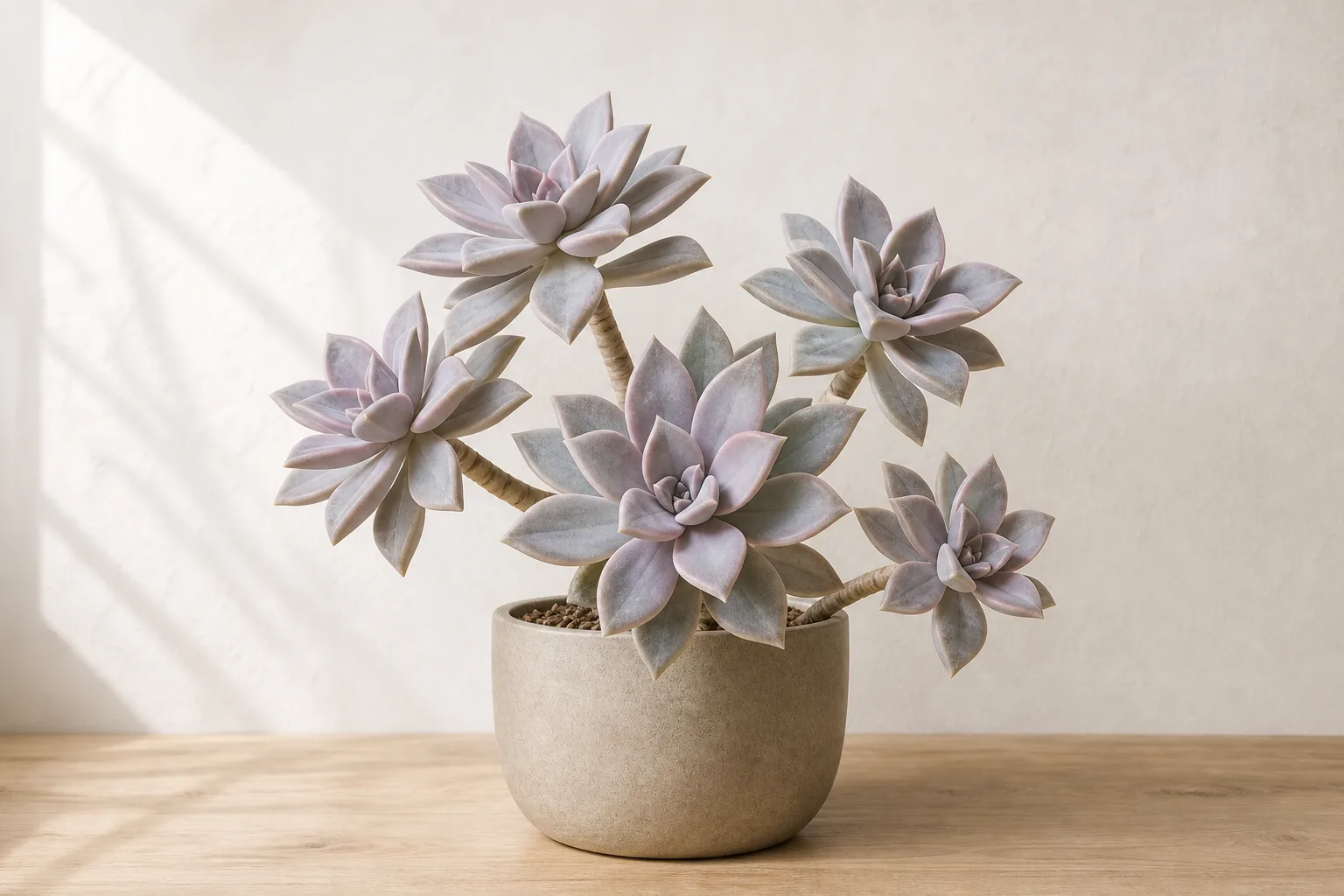
Key takeaways
- Give it bright indirect light to full sun; stronger light brings out pink tones, while shade keeps it blue-gray.
- Water only after the mix has dried out, and reduce watering in winter.
- Root leaves or stem cuttings easily - the leaves fall off readily and each can form a new rosette.
How to care for Ghost Plant
Ghost plant (Graptopetalum paraguayense) is a rosette succulent in the Crassulaceae family, native to the desert and dry shrubland of Tamaulipas in northeastern Mexico. Its fleshy, spatulate leaves carry a chalky, powdery coating and grow on stems that trail or cascade over a pot as they lengthen. In strong light and cool nights the leaves flush soft pink and lilac, which is part of the plant's appeal.
Give it full sun to bright indirect light, a sharply drained mix, and a real dry period between waterings. It tolerates neglect and poor soil, but not soggy roots. The leaves detach easily and will root where they land, so propagation is nearly effortless.
Light
Ghost plant grows best in full sun to bright indirect light. Indoors, a sunny windowsill or a spot in bright filtered light keeps the rosettes compact and colorful, while lower light turns the leaves a blue-gray and stretches the stems. The plant's color is the easiest feedback: move it gradually closer to a brighter window and watch for pink tones, but avoid a sudden jump into harsh midday sun.
Water
Water thoroughly only after the potting mix has dried out, then let excess drain. The plant is drought tolerant and stores water in its leaves, so it recovers from missed waterings better than from constant moisture. In winter, when growth slows, reduce watering substantially. Leaves that wrinkle signal thirst; soft, translucent leaves signal too much water.
Soil and repotting
Use a sharply drained cactus or succulent mix in a container with a drainage hole. Ghost plant tolerates rocky, poor soils and does not need rich mix. Repot only when the plant has clearly outgrown its pot, and be gentle - the leaves and their powdery coating are easily disturbed. Stems can be pruned to keep the plant compact rather than moved to a bigger pot.
Temperature, humidity, and fertilizer
Ghost plant prefers warm, dry conditions and tolerates cool temperatures down to about 15°F (-9°C) when grown outside in protection, but indoors it is comfortable in normal room temperatures. Low humidity is fine, and good airflow helps keep the foliage dry. Feed sparingly, if at all - a diluted succulent fertilizer once or twice in the growing season is enough, and none is needed in winter.
Pruning and propagation
Prune stems back to keep the plant full and compact, and use the removed stems as cuttings. Propagation is easy: stem cuttings and single leaves both root readily. Allow a cut or pulled leaf to callus for a couple of days, then set it on top of dry, gritty mix; roots and a tiny rosette form within a few weeks. The plant spreads naturally by leaves that drop and root on their own.
Common problems
Start with the pattern, current soil moisture, and recent changes. One symptom can have several causes, so change the most likely factor first and observe before making another major adjustment.
| Symptom | Check first | First action |
|---|---|---|
| Leggy, stretched rosettes | Available light and how far the plant sits from the window | Move gradually to a brighter position and prune stems back to encourage compact regrowth. |
| Soft, translucent leaves | Whether the mix is staying wet and whether the pot drains | Withhold water until the mix dries; if the base is mushy, unpot and inspect the roots. |
| Wrinkled leaves | How long since the last watering and the current light level | Water thoroughly if the mix is dry, then let it drain and resume a dry-down cycle. |
| Powdery coating rubbing off | Recent handling - the coating marks on contact and does not regrow | Handle the plant by the pot and avoid touching the leaves; the marks are only cosmetic. |
| Mealybugs in leaf axils | Leaf axils and stem bases for white cottony insects, and nearby plants | Isolate the plant, identify the pest, and use a targeted control rather than a broad drench. |
Pet and household safety
Ghost plant (Graptopetalum paraguayense) is commonly listed as non-toxic to cats, dogs, and horses. Non-toxic does not mean edible: chewing any plant or potting material can still upset a pet's stomach, so discourage persistent chewers and contact a veterinarian if a pet becomes unwell.
Frequently asked questions
How often should I water a ghost plant?
Use the potting mix as the trigger. Water thoroughly after the mix has dried out, then drain. The interval changes with light, pot size, and season, and should lengthen in winter.
What light does a ghost plant need?
Full sun to bright indirect light. Stronger light deepens the pink and lilac tones and keeps the rosettes compact; low light turns the leaves blue-gray and stretches the stems.
Where does ghost plant grow naturally?
It is native to the desert and dry shrubland of Tamaulipas in northeastern Mexico, where it grows in bright, warm, well-drained conditions.
Why is my ghost plant turning green?
Color fades in lower light. Move it gradually toward a brighter window; the pink flush returns in strong light, especially with cooler night temperatures.
How do I propagate a ghost plant?
Stem cuttings and single leaves both root readily. Let the cut end callus for a few days, then place it on or in gritty mix and keep it dry until roots form.
Is ghost plant safe for pets?
It is commonly listed as non-toxic to cats, dogs, and horses. Non-toxic does not mean edible, so still discourage chewing and contact a veterinarian if a pet becomes unwell.
Sources and editorial review
This editorial draft is based on the sources below and awaits named horticulture-expert approval before publication.
- Graptopetalum paraguayenseRoyal Botanic Gardens, Kew (Plants of the World Online) · Checked
- Graptopetalum paraguayense (Ghost Plant)North Carolina State University Extension · Checked
- Graptopetalum paraguayense (mother-of-pearl plant)Royal Horticultural Society · Checked
- Toxic and non-toxic plantsASPCA · Checked
What works well
- Very forgiving and easy for beginners.
- Color shifts between blue-gray and pink with light and temperature.
- Propagates from a single leaf.
What to consider
- Powdery leaf coating marks easily if touched.
- Can look leggy and dull in low light.
- Rot follows wet, poorly drained mix.