Key takeaways
- Give it bright indoor light with no direct sun, and keep the tuber and crown dry at the soil line.
- Water from below or at the soil surface - wet leaves and crown invite gray mold and crown rot.
- After the bloom flush, allow the foliage to die back and the tuber to rest before starting again.
How to care for Florist Gloxinia
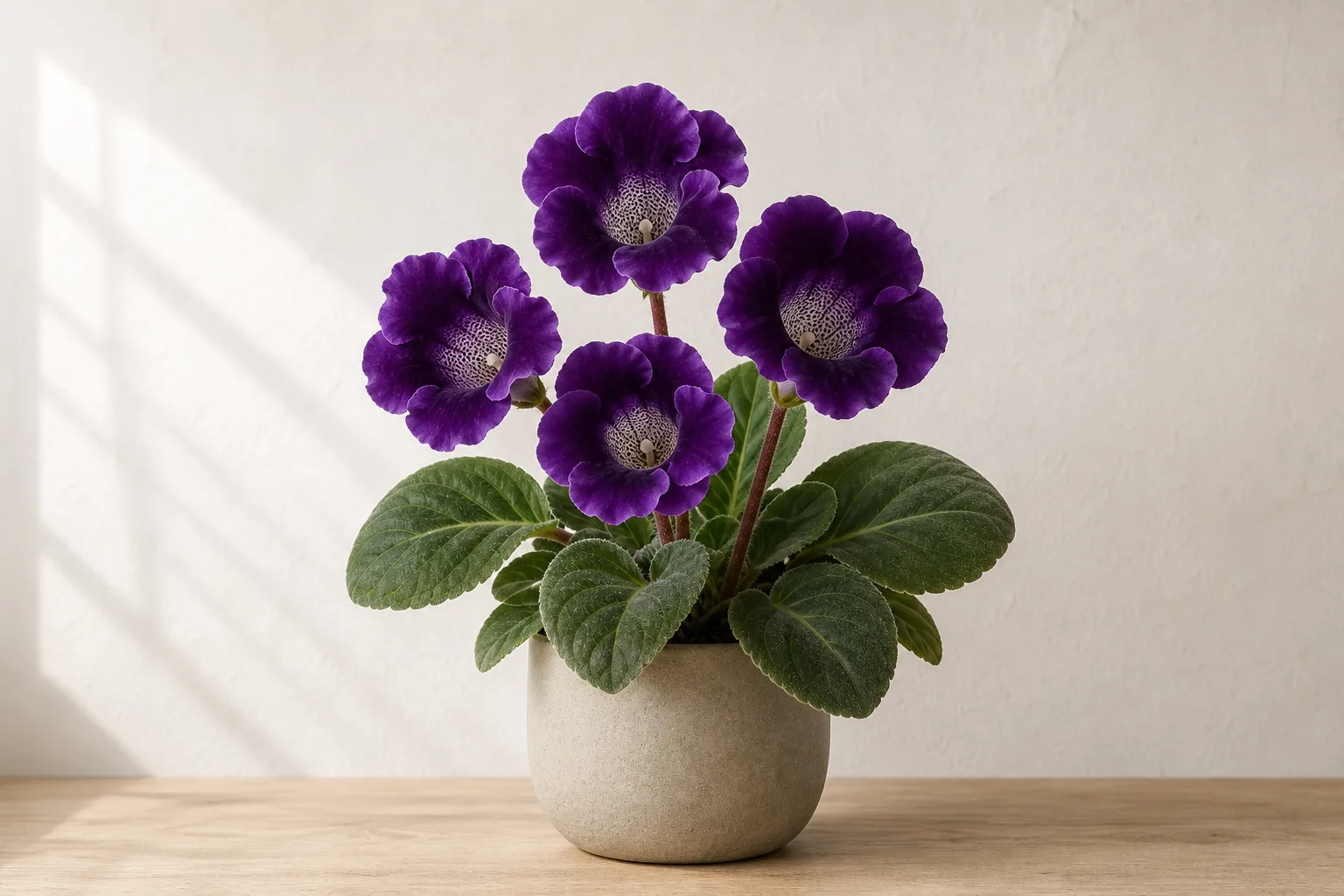
Florist gloxinia (Sinningia speciosa) is a perennial that grows from a tuber, native to southeastern Brazil, in the same family as African violets (Gesneriaceae). It forms a low rosette of large, velvety, ovate leaves and sends up big, trumpet-shaped flowers in lavender, purple, red, or white. Plants sold in bloom by florists are commonly hybrids referred to as florists' gloxinia, with larger flowers in a wider color range.
Give it bright indoor light with no direct sunlight and consistent moisture, keeping water off the fuzzy leaves and crown. After the spring bloom, cut the foliage back to the first two leaves to encourage a second bloom, then let the plant rest - reduce watering until the foliage dies back, and hold the pot in a dark, cool spot until the tuber starts to grow again.
Light
Aim for bright indoor light with no direct sunlight - an east or north window, or a spot set back from a brighter one. Excessive sunlight can scorch the velvety leaves. Good light supports the spring bloom, while too little light produces weak growth and few flowers. Move the plant gradually if you change its position so it can adjust.
Water
Keep the mix consistently moist but never soggy, and water from below or at the soil surface - never overhead, because water on the crown and fuzzy leaves promotes crown rot and gray mold. Use tepid, ideally soft water and empty the saucer after watering. After the second bloom, reduce watering until the foliage dies back, then keep the resting tuber barely moist so it does not dry out completely.
Soil and repotting
Use a peaty, well-draining potting soil in a container with a drainage hole. Plant the tuber about half an inch deep, or at the depth it was previously growing, and keep the crown at the surface. Repot the tuber when it shows new growth after dormancy, moving up one pot size and using fresh mix. Consistent drainage is essential because the crown and roots rot quickly in standing water.
Temperature, humidity, and fertilizer
Florist gloxinia grows best at warm indoor temperatures, roughly 60-75°F (16-24°C), with higher humidity around the leaves - it grows well in greenhouses and bright bathrooms. During dormancy, hold the pot at a uniform 60-65°F (16-18°C) in a dark location and mist the soil lightly so the tuber does not shrink. Feed with a dilute, balanced liquid fertilizer during active growth, and stop feeding during the rest period.
Pruning and propagation
Remove spent flowers and any yellow or dying leaves regularly to keep the plant clean and encourage new blooms. After the first spring bloom, cut the leaves back to the first two leaves for a second flush. Propagation is from leaf cuttings: take leaves at least two inches across in spring, when the plant is most active, and root them in a humid, well-ventilated setting. The tuber can also be divided when it resprouts after dormancy.
Common problems
Start with the pattern, current soil moisture, and recent changes. One symptom can have several causes, so change the most likely factor first and observe before making another major adjustment.
| Symptom | Check first | First action |
|---|---|---|
| Gray mold or crown rot at the base | Whether water has been poured overhead, humidity levels, and air circulation | Stop overhead watering, improve airflow, and remove affected foliage immediately. |
| Wilted or rotting leaves | Root-zone moisture, drainage, and whether the pot sits in water | Check the root zone; withhold water and unpot to inspect the tuber if the mix is still wet. |
| Scorched or bleached leaves | Recent direct sun exposure | Move the plant gradually to bright indoor light without direct sun. |
| No second bloom | Whether the plant was allowed a rest period and whether spent flowers were removed | Cut back after the first bloom, reduce watering, and give the tuber a cool, dark rest before resuming. |
| Aphids, scale, or fungus gnats | New growth, leaf undersides, and wet soil surface | Isolate the plant and identify the pest before treating; let the soil surface dry between waterings. |
Pet and household safety
Florist gloxinia (Sinningia speciosa) is non-toxic to cats and dogs. The ASPCA lists Gloxinia (Sinningia speciosa) as non-toxic to cats, dogs, and horses, and NC State lists Sinningia speciosa as non-toxic for cats, dogs, and horses. Still, 'non-toxic' does not mean edible - chewing any plant material can cause mild stomach upset in pets. Discourage chewing, keep the plant out of reach of curious pets, and contact a veterinarian if a pet seems unwell after eating any part of it.
Frequently asked questions
How often should I water a florist gloxinia?
Keep the mix consistently moist but never soggy, watering from below or at the soil surface. After the bloom flush, reduce watering and let the foliage die back for the tuber's rest period.
What light does a florist gloxinia need?
Bright indoor light with no direct sunlight - an east or north window works well. Direct sun scorches the velvety leaves.
Where does florist gloxinia grow naturally?
It is native to southeastern Brazil, where it grows as a tuberous geophyte or lithophyte in the seasonally dry tropical biome.
Why is my gloxinia not reblooming?
It usually needs a proper rest: after the first bloom, cut the foliage back, reduce watering, and give the tuber a cool, dark dormancy before resuming care in spring.
How do I propagate a florist gloxinia?
Take leaf cuttings at least two inches across in spring and root them in a humid, well-ventilated setting, or divide the tuber when it resprouts after dormancy.
Is florist gloxinia safe for pets?
Yes. The ASPCA lists Sinningia speciosa as non-toxic to cats and dogs, and NC State lists it as non-toxic. Still discourage chewing, since any plant material can cause mild stomach upset.
Sources and editorial review
This editorial draft is based on the sources below and awaits named horticulture-expert approval before publication.
- Sinningia speciosaRoyal Botanic Gardens, Kew (Plants of the World Online) · Checked
- GloxiniaASPCA · Checked
- Sinningia speciosa (Florist's Gloxinia)North Carolina State University Extension · Checked
- Sinningia speciosa (Gloxinia)Missouri Botanical Garden Plant Finder · Checked
What works well
- Large, velvety, trumpet-shaped flowers in rich colors.
- Compact rosette that suits tabletops and bright windowsills.
- Non-toxic to cats, dogs, and horses.
What to consider
- Fuzzy leaves and crown rot easily if watered overhead or overwatered.
- Needs a rest period after flowering to rebloom well.
- Each plant is often treated as a seasonal purchase rather than a permanent houseplant.