Key takeaways
- Give it lots of bright, indirect light but keep it out of direct sun.
- Keep the soil moderately moist in summer and seldom watered in winter.
- It spreads by stolons (runners) that root readily - pinch them to keep the plant full or pot them up.
How to care for Flame Violet
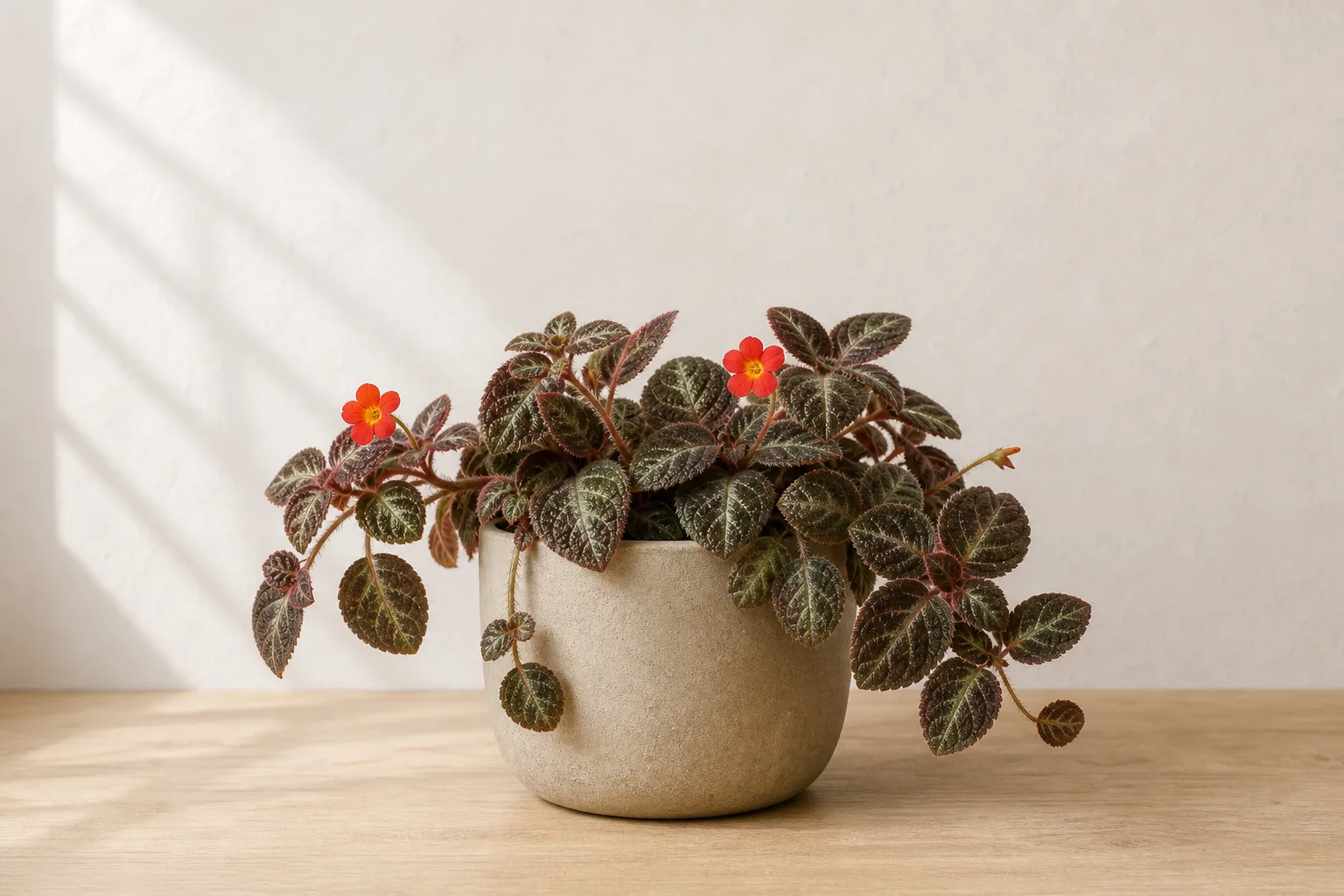
Flame violet (Episcia cupreata) is a herbaceous perennial in the African violet family (Gesneriaceae), native from Nicaragua to northern Brazil, including Colombia, Ecuador, and Venezuela. It has a creeping habit, with oval, velvety, dark green leaves that are coppery or purple underneath, and solitary, scarlet-to-orange, funnel-shaped flowers with yellow throats. It is grown as a houseplant, often in hanging baskets or terrariums.
Give it lots of bright, indirect light and a well-drained potting mix, and water moderately to keep the soil moist in summer and seldom in winter. It needs high humidity but does not tolerate water on its leaves. The plant creeps by stolons, or runners, that readily root, so it fills a basket quickly and is easy to propagate.
Light
Aim for lots of bright, indirect light. Flame violet grows well in a bright room, in a hanging basket set back from a bright window, or under artificial light. Direct sun scorches the leaves - leaf scorch appears in full direct sun. It tolerates heavy shade in a terrarium setting, but too little light produces weak growth and few flowers. Move the plant gradually when changing its position.
Water
Water moderately to keep the soil moist in the summer, and seldom in the winter. Let the top of the mix dry slightly between waterings, and never let the pot sit in standing water. The plant does not tolerate water on its leaves, so water at the soil surface or from below. Too much water, or too little air circulation, causes dieback, and low humidity browns the leaf margins.
Soil and repotting
Use a well-drained, high-organic-matter mix - an African violet mix with added perlite or small gravel works well - in a pot with a drainage hole. Repot in spring using fresh mix and small gravel to increase drainage; the plant is shallow-rooted and creeping, so a wide, shallow container suits it best. Keep the crown at the soil line and avoid burying the stolons.
Temperature, humidity, and fertilizer
Flame violet wants warmth and high humidity - it does well in greenhouses and terrariums, where the air stays moist. Keep it in warm rooms away from cold drafts and dry heat vents. Feed every two weeks in summer with a balanced, diluted liquid fertilizer, and reduce feeding in winter. High humidity and good airflow matter more than heavy feeding; low humidity turns leaf margins brown.
Pruning and propagation
Pinch runners to keep the plant full and compact, and remove spent flowers and yellowing leaves. Propagation is easy because the plant produces stolons that root readily - pot rooted runners directly, or take stem cuttings in late summer and root them in moist mix. Leaf cuttings can also root in humid conditions. A little pruning and pinching keeps the basket dense rather than stringy.
Common problems
Start with the pattern, current soil moisture, and recent changes. One symptom can have several causes, so change the most likely factor first and observe before making another major adjustment.
| Symptom | Check first | First action |
|---|---|---|
| Brown leaf margins | Low humidity, dry air, and whether the plant is too dry | Raise local humidity and even out watering; keep the plant away from dry vents. |
| Leaf scorch in full sun | Recent direct sun exposure and placement near bright windows | Move the plant gradually to bright indirect light and out of direct sun. |
| Dieback or soft stems | Whether the mix is wet, air circulation, and whether water sits on the leaves | Withhold water, improve airflow, and keep water off the foliage. |
| Leggy, sparse growth | Available light and whether runners need pinching | Move gradually to brighter light and pinch runners to encourage a fuller plant. |
| Mealybugs or aphids | Leaf undersides, stolons, and new growth | Isolate the plant and identify the pest before treating; use a targeted control. |
Pet and household safety
Flame violet (Episcia cupreata) is non-toxic to cats and dogs. The ASPCA lists Episcia species as non-toxic to cats and dogs, and NC State lists Episcia cupreata with no toxicity flags for pets. Still, 'non-toxic' does not mean edible - chewing any plant material can cause mild stomach upset in pets. Discourage chewing, keep the plant out of reach of curious pets, and contact a veterinarian if a pet seems unwell after eating any part of it.
Frequently asked questions
How often should I water a flame violet?
Water moderately to keep the soil moist in summer, and seldom in winter. Let the top of the mix dry slightly between waterings, keep water off the leaves, and never leave the pot standing in water.
What light does a flame violet need?
Lots of bright, indirect light. Direct sun scorches the leaves, while too little light gives weak growth and few flowers - a bright room or terrarium suits it well.
Where does flame violet grow naturally?
It is native from Nicaragua to northern Brazil, including Colombia, Ecuador, and Venezuela, where it grows as a creeping subshrub in the wet tropical biome.
Why are the leaf edges on my flame violet turning brown?
Usually low humidity or the plant being kept too dry. Raise local humidity, even out watering, and keep the plant away from dry heat vents.
How do I propagate a flame violet?
Pot the rooted runners (stolons) the plant produces, or take stem or leaf cuttings in late summer and root them in moist mix under humid conditions.
Is flame violet safe for pets?
Yes. The ASPCA lists Episcia as non-toxic to cats and dogs, and NC State lists Episcia cupreata with no toxicity flags. Still discourage chewing, since any plant material can cause mild stomach upset.
Sources and editorial review
This editorial draft is based on the sources below and awaits named horticulture-expert approval before publication.
- Episcia cupreataRoyal Botanic Gardens, Kew (Plants of the World Online) · Checked
- EpisciaASPCA · Checked
- Episcia cupreata (Flame Violet)North Carolina State University Extension · Checked
- Episcia cupreata (Flame Violet)Missouri Botanical Garden Plant Finder · Checked
What works well
- Coppery, velvety leaves with showy orange-scarlet flowers.
- Creeping habit that fills hanging baskets and terrariums.
- Non-toxic to cats and dogs.
What to consider
- Needs high humidity and dislikes water on its leaves.
- High-maintenance; browns quickly in dry air.
- Too much water or poor air circulation causes dieback.