Key takeaways
- Keep it in bright filtered light with high humidity and steady warmth.
- Water evenly so the mix stays moist but never soggy; use distilled or rainwater if tap water browns the tips.
- Non-toxic to cats and dogs per the ASPCA's Calathea listing.
How to care for Eternal Flame
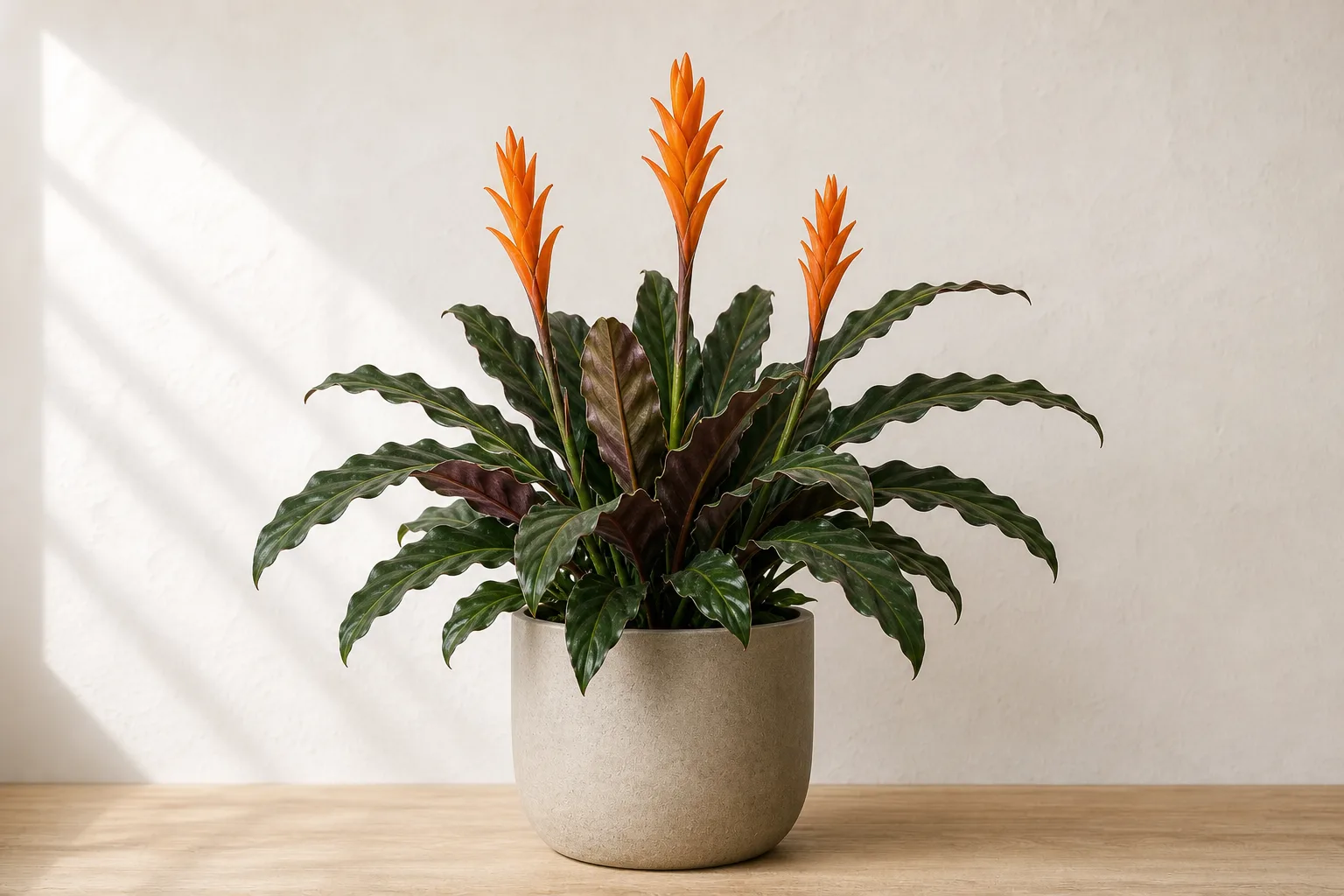
Eternal flame (Goeppertia crocata, formerly Calathea crocata) is a compact, clump-forming evergreen perennial in the prayer plant family (Marantaceae), native to the rainforests of Bahia and Espírito Santo in eastern Brazil. It is grown for two reasons: the elliptic, slightly ridged leaves that are dark green above and maroon or purple beneath, and the striking upright spikes of orange-yellow bracts that rise above the foliage and last for months - the 'flame' behind its common name.
This plant wants what a tropical understory gives it: bright but indirect light, warm and humid air, and a mix that stays evenly moist without being soggy. Room temperatures of 65-80°F (18-27°C) with about 60% humidity suit it best. Keep it away from drafts and sudden temperature changes, and dust the leaves regularly so photosynthesis is not blocked. Propagate by division, which also refreshes aging clumps.
Light
Eternal flame prefers partial shade or bright, filtered indirect light - dappled light through a curtain or a spot a few feet back from a bright window is ideal. Direct sun scorches the leaves, while very dim spots slow growth and reduce flowering. The leaves fold up at night and open by day, a normal prayer-plant behavior. Rotate the pot occasionally and move the plant gradually if you change its position.
Water
Keep the mix evenly moist and never let it dry out completely, but avoid soggy conditions and standing water in the saucer. Watering with distilled or rainwater is recommended, because fluoride and other minerals in tap water brown the leaf edges and tips. In winter, when growth slows, reduce watering slightly while keeping the root zone from drying out. If low humidity causes leaf curl, address humidity first before changing how often you water.
Soil and repotting
Use a moist, well-drained, all-purpose potting mix - ideally airy and rich in organic matter - in a container with a drainage hole. The plant prefers slightly acidic to neutral soil. Repot in spring, moving up one pot size, and handle the roots gently. Repotting is also the natural time to divide the clump into new plants. Keep the divisions warm and humid until they re-establish.
Temperature, humidity, and fertilizer
Eternal flame thrives in warm, humid conditions: keep room temperatures between 65-80°F (18-27°C) with humidity around 60%, and avoid cold drafts and temperature swings. Raise humidity with a pebble tray, a humidifier, or a bright bathroom, or grow the plant in a terrarium or under a cloche. Feed monthly with a balanced liquid fertilizer during the growing season, and reduce feeding in winter when growth slows.
Pruning and propagation
Prune mainly by removing spent flower spikes once they fade and trimming any yellowed or damaged leaves at the base. Propagation is by division: in late spring, when you repot, separate the clump into sections, each with roots and several leaves, and pot them individually. Keep new divisions warm and humid until growth resumes. This plant does not root from stem or leaf cuttings, so division is the reliable method.
Common problems
Start with the pattern, current soil moisture, and recent changes. One symptom can have several causes, so change the most likely factor first and observe before making another major adjustment.
| Symptom | Check first | First action |
|---|---|---|
| Crisp brown leaf edges and tips | Tap water minerals, low humidity, and dry air | Switch to distilled or rainwater and raise humidity with a pebble tray or humidifier. |
| Leaves curling | Humidity and whether the mix is too dry | Check the root zone, water if dry, and raise humidity before changing anything else. |
| Scorched or bleached leaf patches | Direct sun exposure | Move gradually to bright filtered light away from direct rays. |
| Drooping stems or mushy base | Overwatering and drainage | Let the mix dry at the surface, confirm drainage, and inspect roots if it persists. |
| Mealybugs or spider mites | Leaf undersides and surrounding plants | Isolate the plant, identify the pest, and use a targeted control; raise humidity. |
Pet and household safety
The eternal flame plant (Goeppertia crocata, formerly Calathea crocata) is listed as non-toxic to dogs, cats, and horses by the ASPCA under its Calathea listing, and NC State Extension flags the species as non-toxic for cats and dogs. As with any plant material, a pet that chews large amounts may experience mild stomach upset. Keep the plant where pets are unlikely to chew and contact a veterinarian if you observe persistent vomiting, diarrhea, or lethargy. Non-toxic does not mean edible.
Frequently asked questions
How often should I water an eternal flame plant?
Keep the mix evenly moist, watering when the surface begins to dry, and never leave the pot standing in water. The interval changes with light, pot size, season, and humidity.
What light does an eternal flame plant need?
Bright, filtered indirect light, such as dappled light through a curtain. Direct sun scorches the leaves, and dim spots slow growth and flowering.
Where does the eternal flame plant grow naturally?
Goeppertia crocata is native to the rainforests of Bahia and Espírito Santo in eastern Brazil, growing in warm, humid, shaded understory.
Why are the leaf edges on my eternal flame plant turning brown?
Most often tap water minerals such as fluoride, or low humidity. Switch to distilled or rainwater and raise humidity; brown edges already present will not recover, but new growth will be clean.
How do I propagate an eternal flame plant?
Divide the clump in late spring at repotting, making sure each section has roots and leaves. Stem and leaf cuttings do not work for this species.
Is the eternal flame plant safe for pets?
Yes. The ASPCA lists Calathea (Calathea spp.) as non-toxic to dogs, cats, and horses, though heavy chewing of any plant can still cause mild stomach upset.
Sources and editorial review
This editorial draft is based on the sources below and awaits named horticulture-expert approval before publication.
- Goeppertia crocataRoyal Botanic Gardens, Kew (Plants of the World Online) · Checked
- CalatheaASPCA · Checked
- Goeppertia crocata (Eternal Flame Plant)North Carolina State University Extension · Checked
- Goeppertia crocata (Saffron-coloured Calathea)Royal Horticultural Society · Checked
What works well
- Long-lasting torch-like orange bracts that last up to three months.
- Glossy, dark green leaves with maroon undersides give year-round color.
- Non-toxic to cats and dogs per the ASPCA.
What to consider
- Demands high humidity and stable, warm conditions.
- Sensitive to tap water minerals, which brown the leaf edges.
- Advanced-level care; leaf curl and tip burn appear quickly when conditions slip.