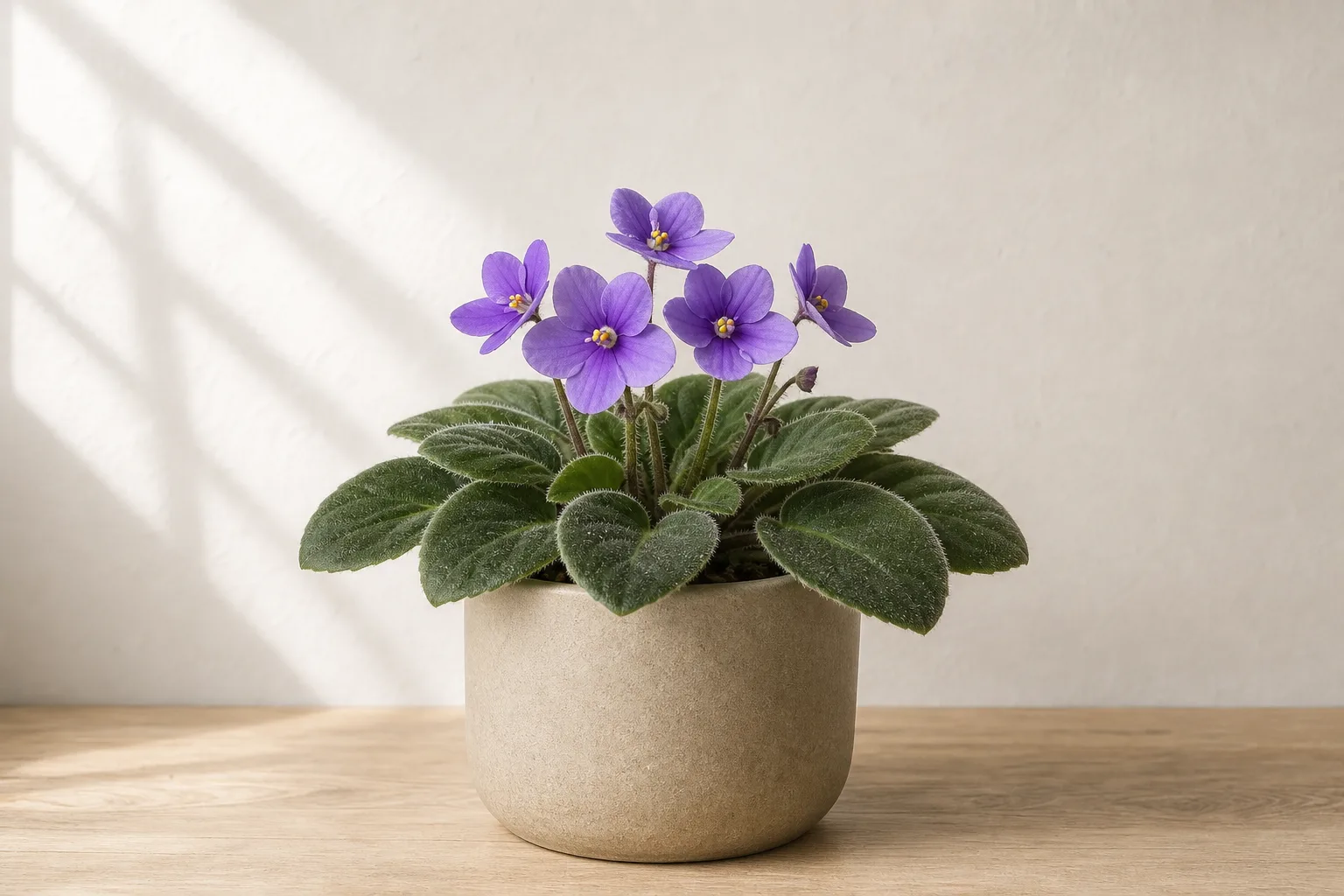
Key takeaways
- Give bright, indirect light for 10-12 hours a day to keep it blooming.
- Water from below or carefully from the top, keeping the fuzzy crown and leaves dry.
- Non-toxic to cats and dogs, a safe choice for pet households.
How to care for African Violet
African violet (Streptocarpus ionanthus) comes from the humid, shaded cloud forests of Tanzania and neighboring East Africa. In the home it wants the same things those conditions provide: bright but filtered light, steady warmth, and moisture that reaches the roots without soaking the fuzzy foliage. Given that balance, it can flower on and off for most of the year.
The two habits that matter most are light and watering. Too little light means lush leaves but few flowers; water on the crown or leaves causes spotting and rot. Water from below, let the surface dry between drinks, and give it 10-12 hours of bright indirect light. Repot only to renew crowded plants, and use a light, slightly acidic African-violet mix.
Light
Aim for bright, indirect light for about 10-12 hours a day. A north, northwest, or east window works well; too little light produces leafy but flowerless plants, while direct sun scorches the soft leaves. If natural light is limited, fluorescent or LED grow lights 10-12 hours daily are excellent. Rotate the pot occasionally for even growth. The plant is comfortable at the same temperatures we are (around 70°F / 21°C).
Water
Water from below by setting the pot in a saucer or bowl of room-temperature water until the surface feels moist, then drain - or water carefully from the top, avoiding the crown and leaves. Always let the soil surface dry between waterings; overwatering is a common cause of death through crown and root rot. Use room-temperature distilled, rain, or reverse-osmosis water if your tap water is softened or heavily chlorinated. A wick can provide steady moisture for forgetful waterers.
Soil and repotting
Use a light, well-draining, slightly acidic soilless mix (pH about 6.2-6.5), such as a commercial African-violet blend or peat-perlite-vermiculite. The plant has fine, shallow roots and prefers to be slightly pot-bound, so repot only about once a year into a pot just large enough. Always use a container with drainage holes and never let the plant sit in water. Remove the plant from the pot to renew crowded or sour mix.
Temperature, humidity, and fertilizer
African violets thrive at 60-80°F (15-27°C) - if you are comfortable, they usually are - with 40-60% humidity. Average home humidity is workable; group plants or use a pebble tray if the air is very dry. Feed with a fertilizer formulated for African violets at about one-quarter strength every few weeks during active growth, and always moisten the mix with plain water before feeding to avoid root burn. Avoid high-urea fertilizers.
Pruning and propagation
Remove spent flowers and any dead or yellowing leaves at the base to keep the plant tidy and discourage pests. Propagate from a leaf cutting: take a healthy mature leaf with about an inch of stem, let the cut dry briefly, then set it in moist vermiculite, perlite, or water. Tiny plantlets form at the base in roughly three to four weeks (sometimes longer); once they have a few leaves and roots, separate and pot them. Cyclamen mites and mealybugs spread easily, so inspect new cuttings.
Common problems
Start with the pattern, current soil moisture, and recent changes. One symptom can have several causes, so change the most likely factor first and observe before making another major adjustment.
| Symptom | Check first | First action |
|---|---|---|
| No flowers, only leaves | Daily light hours and intensity, and whether the plant is too pot-bound | Increase bright indirect light to 10-12 hours; avoid moving it abruptly. |
| Crown rot or wilting after watering | Whether water landed on the crown or leaves and recent overwatering | Water from below, keep the crown dry, and let the surface dry before the next drink. |
| Brown or spotted leaf centers | Water on leaves, fertilizer splash, or cold drafts | Water from below, keep foliage dry, and shield from drafts. |
| Distorted or stunted new growth | Cyclamen mites or mealybugs, and crowding of plants | Isolate the plant and inspect closely; treat mites early as they spread fast. |
| Pale, stretched leaves | Light level and distance from the window | Move gradually to brighter filtered light. |
Pet and household safety
African violet is non-toxic to cats, dogs, and horses according to the ASPCA, and its fuzzy leaves do not irritate skin - a safe choice for homes with pets. Non-toxic does not mean edible, so it is still best to discourage chewing and to contact a veterinarian if a pet becomes unwell after eating any plant material.
Frequently asked questions
How often should I water an African violet?
Water from below and let the soil surface dry between drinks rather than following a fixed schedule. Overwatering causes crown and root rot, a leading cause of failure.
What light does an African violet need to bloom?
Bright, indirect light for about 10-12 hours a day. Too little light means leaves but few flowers; a grow light works well in dim homes.
Where does the African violet come from?
It is native to the cloud forests of Tanzania and neighboring East Africa, which is why it likes warm, humid, filtered-light conditions indoors.
Why won't my African violet flower?
Most often insufficient light. Increase bright filtered light to 10-12 hours daily and avoid overpotting; flowers follow good light more than heavy feeding.
How do I propagate an African violet?
From a leaf cutting with an inch of stem, rooted in moist vermiculite, perlite, or water. Plantlets appear at the base in a few weeks and can be potted individually.
Is African violet safe for pets?
Yes - the ASPCA lists it as non-toxic to cats and dogs, and the leaves are not skin-irritating. Still discourage chewing and call a vet if a pet seems unwell.
Sources and editorial review
This editorial draft is based on the sources below and awaits named horticulture-expert approval before publication.
- African VioletsUniversity of Illinois Extension · Checked
- African violetsUniversity of Minnesota Extension · Checked
- African VioletASPCA · Checked
- Streptocarpus ionanthusRoyal Botanic Gardens, Kew (Plants of the World Online) · Checked
What works well
- Blooms repeatedly through the year under good light.
- Compact and ideal for windowsills and small spaces.
- Non-toxic to pets and people.
What to consider
- Sensitive to crown rot from water on the leaves.
- Needs more light than many other easy houseplants to flower.
- Prone to cyclamen mites and mealybugs if crowded or stressed.